
 EN · English
 DE · Deutsch
 ES · Español
 FR · Français

Gezondheid van de darmen van Franse Bulldog: Waarom hun darmen nooit rusten
SAMENVATTING
French Bulldogs are the UK’s most registered breed, yet they carry a disproportionate burden of gastrointestinal disease. Brachycephalic anatomy creates a cascade from the mouth downward: aerophagia, oesophageal dysmotility, hiatal herniation, chronic reflux, and delayed gastric emptying are all well-documented consequences of the compressed upper airway. Research shows that French Bulldogs have the highest prevalence of GI signs among brachycephalic breeds, with rates exceeding 90% in some clinical populations. Beyond anatomy, Frenchies are genetically predisposed to a breed-specific form of granulomatous colitis, elevated atopy rates, and gut dysbiosis that activates the gut-skin axis. This article explains the mechanisms behind each of these challenges, why French Bulldog gut health requires dedicated dietary and microbiome support, and how targeted bioactive nutrition can address the root causes rather than the symptoms.
INTRO
When French Bulldog owners joke that their dog is “always gassy,” they are describing a physiological reality, not a charming quirk. French Bulldog gut health is compromised by a set of overlapping factors that no other breed experiences in quite the same combination. First is anatomy: the shortened skull that defines the breed also deforms the entire upper aerodigestive tract, creating negative pressure that pulls gastric acid upward, distorts oesophageal motility, and floods the gut with swallowed air. Second is immunology: the breed carries a documented genetic predisposition to atopic dermatitis, gut dysbiosis, and a specific form of inflammatory bowel disease tied to invasive bacteria. Third is the gut-skin axis: in French Bulldogs, what shows on the skin almost always starts in the gut.
Dit zijn geen afzonderlijke problemen. Het zijn onderling verbonden uitingen van één gecompromitteerd systeem en ze vereisen een reactie die de darm op elk niveau aanpakt: integriteit van de barrière, microbiële balans, immuunmodulatie en veerkracht van het slijmvlies.
BELANGRIJKSTE OPMERKINGEN
- French Bulldogs have the highest prevalence of gastrointestinal disease among brachycephalic breeds, driven by anatomy, not just diet.¹
- Aerofagie (het inslikken van lucht) is een direct gevolg van de samengedrukte bovenste luchtweg en een primaire oorzaak van een opgeblazen gevoel en winderigheid.
- Controle van de slokdarm pH heeft aangetoond dat abnormale zure reflux optreedt bij 84% van de brachycefale honden, waarbij Franse Bulldoggen de dominante onderzochte groep zijn.
- Franse Bulldoggen behoren tot een klein aantal rassen die aanleg hebben voor granulomateuze colitis, een ernstige IBD-variant die in verband wordt gebracht met invasieve Escherichia coli.⁶
- Het ras heeft een gedocumenteerde genetische gevoeligheid voor atopische dermatitis, en dysbiose van de darmen wordt nu erkend als een drijvende kracht achter huidontsteking via de darm-huidas.⁸˒⁹
- Gerichte ondersteuning van het microbioom, herstel van de darmbarrière en modulatie van mastcellen pakken de darmgezondheid van de Franse Bulldog bij de wortel aan.
In deze gids
- De anatomie achter het probleem: hoe Brachycephalic Conformation darmdysfunctie veroorzaakt
- Aerofagie, Hiatale Herniatie en chronische reflux
- Darmdysbiose bij Franse Bulldoggen: Wat het onderzoek aantoont
- Granulomateuze Colitis: Een rasspecifieke IBD-variant
- Voedselgevoeligheid, atopie en de darm-huidas
- Franse Bulldog Winderigheid: Symptoom, geen gril
- Hoe Bonza de darmgezondheid van de Franse Bulldog ondersteunt
- De darmgezondheid van uw Franse Bulldog ondersteunen: Een praktische gids
- Veiligheidsoverwegingen en wanneer naar de dierenarts gaan
- Veelgestelde vragen
- Conclusie
- Verwante artikelen
- Referenties
- Redactionele informatie
De anatomie achter het probleem: hoe Brachycephalic Conformation darmdysfunctie veroorzaakt
Het kenmerkende platte gezicht van de Franse Bulldog is niet zomaar een esthetische eigenschap. Het is het resultaat van selectief fokken op extreme compressie van de schedel, waardoor de zachte weefsels van de neus en keel worden samengedrukt in een aanzienlijk kleinere ruimte, terwijl het volume van deze weefsels grotendeels onveranderd blijft. Het resulterende syndroom, het brachycephalic obstructive airway syndrome (BOAS), creëert een chronische weerstand van de bovenste luchtwegen en een negatieve intrathoracale druk bij elke ademhaling.
Die negatieve druk stopt niet bij de longen. Het verspreidt zich naar beneden door de slokdarm en in het bovenste deel van het spijsverteringskanaal, vervormt de slokdarmmotiliteit, vergemakkelijkt maagreflux en bevordert de ontwikkeling van glijdende hiatale hernia’s. Een baanbrekende studie van 73 brachycephale honden toonde aan dat 97% slokdarm-, maag-, of twaalfvingerige anomalieën had bij endoscopische evaluatie, waarbij Franse Bulldoggen een statistisch sterkere correlatie vertoonden tussen respiratoire ernst en digestieve ernst dan welk ander brachycephalisch ras dan ook.⁴
A subsequent UK surveillance study using data from over 500 primary care practices confirmed this breed-specific pattern: French Bulldogs had significantly increased odds of oesophageal, gastric, and intestinal disease relative to Bulldogs and Pugs, and carried the highest overall incidence of gastrointestinal disease across all three breeds studied.² This is not a reflection of diet or owner management. It is a structural consequence of the breed standard.
The most observed digestive diseases in brachycephalic dogs affected by BOAS include oesophagitis, redundant oesophagus, sliding hiatal hernia, delayed gastric emptying, gastritis, pyloric mucosal fold hypertrophy, and duodenitis. In French Bulldogs, these conditions are more prevalent and more severe than in comparable brachycephalic breeds.²
Aerofagie, Hiatale Herniatie en chronische reflux
Aerofagie, de medische term voor overmatig lucht inslikken, is een van de meest directe gevolgen van brachycefale anatomie. Als een hond hard moet werken tegen een vernauwde bovenste luchtweg om te ademen, slikt hij onwillekeurig lucht in bij elke moeizame ademhaling. Deze lucht hoopt zich op in de maag, draagt bij aan een opgeblazen en opgezwollen gevoel en verhoogt de intragastrische druk op een manier die zowel reflux als winderigheid in de hand werkt.
De combinatie van aerofagie en slokdarm dysmotiliteit creëert een specifiek probleem voor Franse Bulldoggen: de gastro-oesofageale junctie wordt functioneel gecompromitteerd. In een case review studie waarbij 24-uurs oesofageale pH-monitoring werd gebruikt bij 51 brachycephale honden (waarvan 35 Franse Bulldoggen), vertoonde 84% abnormale zure reflux, met een mediane distale zuurblootstellingstijd die ver boven de normale drempelwaarden lag.⁵ Kritisch genoeg was de ernst van de reflux niet sterk gecorreleerd met hoe ziek de hond klinisch leek, wat betekent dat aanzienlijke oesofageale zure schade kan optreden bij honden waarvan de eigenaren vinden dat ze gezond en normaal zijn.
Hiatale herniatie, waarbij een deel van de maag via het middenrif omhoog schuift, komt vooral voor bij dit ras. Dit tast de anti-refluxbarrière verder aan, verergert de blootstelling van het slokdarmslijmvlies aan zuur en kan zich presenteren met ofwel GI-symptomen, respiratoire symptomen of beide tegelijk. Het is een bron van chronische, laaggradige slijmvliesontsteking die de toch al hoge ontstekingsbelasting van het ras nog verergert.
Dit chronische zuurmilieu in de slokdarm is niet alleen onaangenaam. Aanhoudende blootstelling aan zuur beschadigt het slokdarmslijmvlies en kan proximale mucosale veranderingen teweegbrengen die het ontstekingssignaal uitbreiden naar de maag en proximale darm. Het beheersen van deze systemische ontstekingsdruk staat centraal bij het aanpakken van de darmgezondheid van de Franse Bulldog als geheel.
Darmdysbiose bij Franse Bulldoggen: Wat het onderzoek aantoont
Beyond the mechanical and anatomical drivers of GI disease, French Bulldogs carry a documented predisposition to gut dysbiosis, the disruption of microbial community composition and function that underlies many chronic health conditions. Dysbiosis in the canine gut typically manifests as an increase in Proteobacteria (including E. coli), a depletion of beneficial Firmicutes such as Faecalibacterium and Clostridia, and a reduction in overall microbial diversity and short-chain fatty acid production.⁷
In French Bulldogs, this dysbiotic pattern has both mechanical and immunological drivers. Chronic acid reflux and altered gastric emptying alter the pH and substrate environment of the proximal intestine, creating conditions that favour opportunistic bacteria over beneficial commensals. Antimicrobial treatments, which are frequently used in the breed for recurrent skin infections associated with atopy, further disrupt the microbiome. Repeat veterinary antibiotic exposure is one of the most potent predictors of gut dysbiosis in companion animals.⁷
The contributes to host metabolism, barrier function, immune regulation, and neuroendocrine signalling. When this system is chronically disturbed, the consequences extend far beyond loose stools. Altered SCFA production reduces colonocyte fuel supply and mucosal barrier integrity. Reduced microbial diversity impairs immune education. Elevated Proteobacteria increases the likelihood of mucosal inflammation and systemic antigen translocation.
Granulomateuze Colitis: Een rasspecifieke IBD-variant
One of the most clinically significant aspects of French Bulldog gut health is the breed’s documented susceptibility to granulomatous colitis (GC), a severe inflammatory bowel disease that closely resembles the histiocytic ulcerative colitis seen in Boxer dogs. A Cornell University study characterised GC in six French Bulldogs, finding that the condition is associated with mucosally invasive Escherichia coli and closely parallels the pattern seen in Boxers.⁶ Genetic susceptibility in both breeds is linked to a region encoding the CD48/SLAM family of genes on chromosome 38, which is implicated in the selective sensing and killing of intracellular E. coli.
Clinical signs include chronic large-bowel diarrhoea, hematochezia, tenesmus, and in severe cases, hypoalbuminaemia and weight loss. The condition typically affects young dogs and often presents with a protracted clinical history of diarrhoea unresponsive to standard treatments. Diagnosis requires colonoscopic biopsy with periodic acid-Schiff staining and fluorescence in situ hybridisation to identify invasive E. coli within colonic macrophages.
For owners of young French Bulldogs with persistent large-bowel diarrhoea that fails to respond to dietary management or short-course antimicrobials, GC should be on the diagnostic list. It is not a common condition in the general dog population, but its concentration in French Bulldogs and Boxers makes it a breed-relevant concern that warrants veterinary investigation rather than repeated empirical treatment.
Voedselgevoeligheid, atopie en de darm-huidas
French Bulldogs are among a small number of breeds consistently identified in the peer-reviewed literature as having elevated risk for canine atopic dermatitis (CAD). Multiple population studies have placed the French Bulldog alongside the Golden Retriever, Labrador Retriever, German Shepherd, and West Highland White Terrier as a breed with significantly increased odds of developing CAD.⁸˒⁹ The condition is driven by a combination of genetic susceptibility, epidermal barrier dysfunction, and immune dysregulation that biases the immune system toward Th2-mediated allergic responses.
What makes the gut-skin connection particularly relevant in French Bulldogs is the growing body of evidence linking gut dysbiosis to CAD severity. A 2025 study found significantly lower gut microbial diversity in dogs with CAD compared to healthy controls, with a strong inverse correlation between alpha diversity and CADESI clinical score.⁸ The worse the gut dysbiosis, the worse the skin disease. Probiotic administration over 16 weeks improved both gut microbial diversity and clinical skin scores, reinforcing the functional nature of the gut-skin axis in this condition.
A comprehensive review of the relationship between atopic dermatitis and the intestinal microbiota in dogs concluded that skin disease may represent a manifestation of a systemic problem involving gut dysbiosis and increased intestinal permeability, even in the absence of overt GI signs.⁹ This finding has direct implications for French Bulldog owners whose dogs present with skin and ear problems: the gut may be the origin of the inflammatory signal, regardless of whether digestive symptoms are visible.
See also: The Darm-huid Axis in Dogs: Why Skin Problems Start in the Gut
Food-responsive enteropathy (FRE) and cutaneous adverse food reactions (CAFR) are also disproportionately represented in French Bulldogs. Dietary antigens that cross a compromised gut barrier trigger local and systemic immune activation, with the skin and GI tract as the primary sites of expression. In a breed where the gut barrier is already under mechanical pressure from aerophagia and reflux, the additional burden of antigenic translocation through a leaky epithelium compounds the inflammatory load substantially.
See also: The Gut-Immune Axis in Dogs: How Gut Health Supports Immune Health
Franse Bulldog Winderigheid: Symptoom, geen gril
Het is verleidelijk om Franse Bulldog winderigheid te normaliseren als “gewoon wat ze doen”. Maar chronische winderigheid bij een Franse Bulldog is een klinisch signaal, geen persoonlijkheidskenmerk. Het wijst op een combinatie van aerofagie, darmfermentatie van onverteerde substraten en microbiële dysbiose die overmatig gas produceert. Ze zijn alle drie adresseerbaar.
Aerofagie draagt gas direct bij tijdens het slikken. Wanneer lucht zich ophoopt in de maag en dunne darm, moet het ergens uit. Bij brachycephale honden wordt de doorvoer door het spijsverteringskanaal al beïnvloed door dysmotiliteit en veranderde pH-gradiënten, wat betekent dat gasophoping waarschijnlijker is en langer duurt dan bij niet-brachycephale rassen.
Fermentation-driven flatulence reflects the microbial composition of the colon. When beneficial SCFA-producing bacteria are depleted and opportunistic gas-producers dominate, fermentation produces hydrogen and methane rather than the short-chain fatty acids that benefit the host. Restoring microbial balance reduces this fermentative gas production at source.
A highly digestible, low-flatulence diet with appropriate prebiotic fibre to feed beneficial bacteria, paired with targeted probiotic support, addresses both pathways. Feeding smaller, more frequent meals reduces the volume of substrate available for fermentation at any one time and reduces the aerophagia associated with rapid eating.
Hoe Bonza de darmgezondheid van de Franse Bulldog ondersteunt
For French Bulldogs, the lead Bonza product is Block. Its formulation addresses the four core mechanisms driving gut-skin pathology in the breed, and each ingredient tier has a specific rationale grounded in the breed’s documented biology.
The first mechanism is mast cell and histamine dysregulation. French Bulldogs with atopy produce excess histamine via mast cell degranulation, amplifying the itch-inflammation cycle. Block provides quercetin, a bioflavonoid with well-characterised mast cell-stabilising activity, alongside stinging nettle, which supports a balanced histamine response through a complementary mechanism. Together, these ingredients address the allergic signalling that drives skin inflammation from an immune perspective.
The second mechanism is gut barrier compromise. The combined pressure of reflux, aerophagia, and microbial dysbiosis in French Bulldogs creates conditions that increase intestinal permeability and allow dietary antigens to cross the mucosal barrier. Block provides L-Glutamine at 16,250mg/kg, the primary fuel source for intestinal enterocytes and the most direct nutritional input for tight junction integrity. Repairing the barrier at its structural level reduces the antigenic load reaching the systemic immune system.
The third mechanism is epidermal barrier dysfunction. French Bulldogs with CAD have impaired skin barrier function driven in part by a relative deficiency in gamma-linolenic acid (GLA) and structural omega-6 fatty acids. Block provides GLA from both primrose oil en borage oil to support the ceramide and structural lipid composition of the skin barrier, reducing transepidermal water loss and providing the physical resistance that limits allergen penetration.
The fourth mechanism is the underlying dysbiosis driving the entire gut-skin axis. Block delivers the full Biotics Triad: prebiotics to feed beneficial bacteria, a live probiotic (Calsporin, Bacillus velezensis DSM 15544) for microbial restoration, and postbiotics that support mucosal immune function independent of live microbial viability.
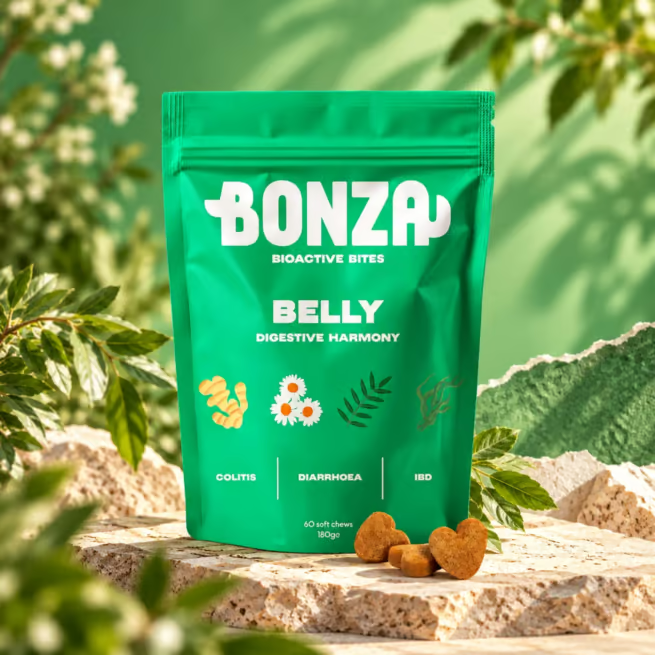
For French Bulldog owners whose primary concern is gut function rather than skin, Biotics provides focused microbiome support. For dogs presenting primarily with digestive sensitivity, loose stools, or post-antibiotic gut disruption, Belly addresses the immediate digestive comfort layer. Block remains the recommended foundation product for the breed given the convergence of gut-skin axis drivers documented in the research.
For a full breakdown of how Biotics, Block, and Belly each address a different layer of this breed’s gut vulnerability — and how to build the protocol correctly — see the Best Gut Health Supplements for French Bulldogs: A Canine Nutritionist’s Guide.
For a full explanation of the three-layer prebiotic, probiotic and postbiotic framework that underpins these recommendations, see Gut Health Supplements for Dogs: Why Probiotics Alone Are Not Enough.
De darmgezondheid van uw Franse Bulldog ondersteunen: Een praktische gids
Betekenisvolle verbetering in de darmgezondheid van Franse Bulldoggen vereist consistentie in voeding, voedingsmanagement en gerichte suppletie. De volgende stappen zijn gericht op zowel de anatomische als de microbiome factoren van GI-disfunctie bij het ras en zijn ontworpen om in de loop van de tijd cumulatief te werken.
- Overgang naar een licht verteerbaar, plantaardig dieet met de juiste vezeldiversiteit
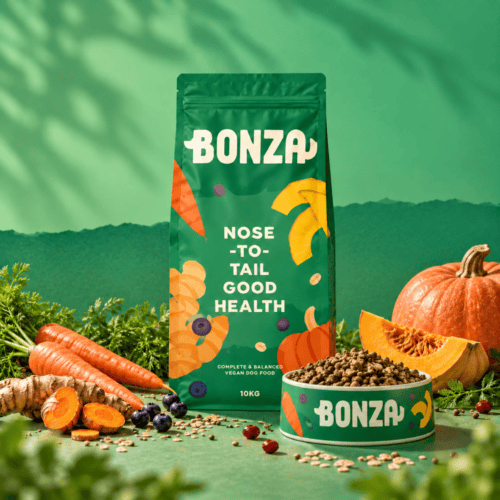
Bonza’s Superfoods and Ancient Grains biedt het prebiotische substraat en de spijsverteringsondersteuning die Frenchies nodig hebben. Introduceer over een periode van 7 tot 10 dagen om het microbioom de kans te geven zich aan te passen zonder losse ontlasting te veroorzaken.
- Block introduceren als het belangrijkste dagelijkse supplement
Begin met de aanbevolen onderhoudsdosis. Block richt zich op mastcelactiviteit, integriteit van de darmbarrière, structuur van de huidbarrière en evenwicht van het microbioom in één enkele dagelijkse portie. Voor een gewicht van minder dan 10 kg, gebruik de richtlijnen voor de kleinere rasdosis op de verpakking.
- Geef kleinere, frequentere maaltijden
Het opsplitsen van het dagelijkse rantsoen in twee maaltijden vermindert het volume dat op elk moment beschikbaar is voor fermentatieve gasproductie en vermindert de aerofagie die gepaard gaat met competitief of snel eten. Voor honden die snel eten, vermindert een voerbak met langzame voedering het inslikken van lucht aanzienlijk.
- Zet de voerbak iets omhoog
Een licht verhoogde kom ondersteunt de slokdarmdrainage en vermindert het ophopen van terugvloeiende vloeistof in de distale slokdarm na het eten. Vermijd te hoge posities waarbij de nek gestrekt moet worden, omdat dit de slikproblemen in verband met BOAS kan verergeren. Een paar centimeter van de vloer is meestal voldoende.
- Vermijd lichaamsbeweging vlak voor en na de maaltijd
Lichamelijke inspanning rond etenstijd verhoogt de drukgradiënt over de gastro-oesofageale junctie en verergert reflux. Neem ten minste 30 minuten de tijd aan weerszijden van de maaltijd voor elke matige activiteit.
- Bespreek het gebruik van antibiotica verstandig met je dierenarts
Antimicrobial disruption to the French Bulldog microbiome is a significant risk factor for worsening gut dysbiosis. When antibiotic treatment is unavoidable, continue or increase probiotic supplementation during and for at least four weeks after the course.
For guidance on how to sequence Biotics Bioactive Bites specifically during and after antibiotic treatment — including why its spore-forming probiotic is not inactivated by antibiotics — see the Best Gut Health Supplements for French Bulldogs guide. - Controleer de consistentie van de ontlasting als indicator voor de gezondheid van de darmen
Aim for a score of 3 to 4 on the Bristol Stool Scale equivalent for dogs, the Dog Fecal Scoring System. Chronically soft or formed-but-mucus-coated stools both suggest ongoing intestinal inflammation or dysbiosis. Keep a simple weekly log when starting a new supplement protocol to track trend direction.
For detailed guidance on sequencing Biotics, Block, and Belly alongside antibiotic courses and during skin flare cycles, see the full French Bulldog supplement protocol.
Veiligheidsoverwegingen en wanneer naar de dierenarts gaan
Bonza Block is samengesteld voor volwassen honden en wordt over het algemeen goed verdragen door Franse Bulldoggen in alle levensstadia voorbij de overgang naar volwassen voeding. Zoals bij elke nieuwe supplement introductie, begin met een halve dosis voor de eerste week om het spijsverteringsstelsel de kans te geven zich aan te passen, vooral bij honden met bestaande GI-gevoeligheid.
The bioactive ingredients in Block, including quercetin, L-Glutamine, and GLA, have established safety profiles at nutritional dosing levels. Stinging nettle is appropriate for dogs without known plant sensitivities. GLA from borage and primrose oil is appropriate for adults but should not be introduced to pregnant or lactating females without veterinary guidance.
Ga naar de dierenarts als je Franse Bulldog een van de volgende verschijnselen vertoont:
- Persistent vomiting or regurgitation occurring more than twice weekly
- Bloederige, zwarte of constant met slijm bedekte ontlasting
- Snel, onbedoeld gewichtsverlies in twee tot vier weken
- Zichtbare zwelling van de buik die niet binnen een uur verdwijnt
- Diarree die langer dan 48 uur aanhoudt zonder verbetering
- Hematochezia (vers bloed in de ontlasting) bij een jonge hond, wat onderzoek naar granulomateuze colitis rechtvaardigt
- Elke combinatie van chronische diarree, hypoalbuminemie en slechte conditie bij een hond jonger dan drie jaar
De GI-symptomen van Franse Bulldoggen overlappen vaak tussen anatomische, inflammatoire en microbiome oorzaken. Suppletie kan het microbioom en de barrière zinvol ondersteunen, maar structurele aandoeningen zoals hiatale hernia, pylorische stenose en dysmotiliteit van de slokdarm vereisen een veterinaire diagnose en behandeling. Bioactieve voeding werkt het meest effectief als aanvulling op diergeneeskundige zorg, niet als vervanging ervan.
Veelgestelde vragen
Spijsverteringsproblemen bij Franse Bulldoggen komen voornamelijk voort uit de brachycephale anatomie. De samengedrukte bovenste luchtweg creëert negatieve druk die de slokdarmmotiliteit verstoort, maagreflux bevordert en overmatig lucht inslikken veroorzaakt. Dit wordt nog verergerd door rasgebonden aanleg voor darmdysbiose, voedselgevoeligheid en een specifieke vorm van IBD. Het resultaat is een ras waar GI-problemen bijna universeel zijn in plaats van uitzonderlijk.
Het komt vaak voor, maar het is niet normaal in de zin van gezond of onvermijdelijk. Franse Bulldog winderigheid weerspiegelt aerofagie, dysbiotische fermentatie of beide. Aanpassing van het dieet, voedingsmanagement en ondersteuning van het microbioom kunnen dit bij de meeste honden aanzienlijk verminderen.
A highly digestible diet with diverse prebiotic fibre, low antigenic load, and consistent protein and carbohydrate sources supports the sensitive French Bulldog stomach best. Novel protein or hydrolysed diets are warranted when food-responsive enteropathy is suspected. Bonza’s Superfoods and Ancient Grains provides the fibre diversity and digestibility profile appropriate for the breed.
Yes, and this is one of the most important principles in French Bulldog health management. The gut-skin axis is well-documented in veterinary science: gut dysbiosis reduces microbial diversity, increases intestinal permeability, and drives systemic immune activation that manifests as atopic skin disease. Improving gut microbiome diversity and barrier integrity directly supports skin health.
Franse Bulldoggen behoren tot de rassen die aanleg hebben voor een specifieke vorm van IBD, granulomateuze colitis genaamd, die wordt geassocieerd met mucosaal invasieve Escherichia coli. Het komt meestal voor bij jonge honden met chronische, bloederige dikke darm diarree en vereist een gespecialiseerde diagnose en behandeling. Bredere inflammatoire darmziektepatronen veroorzaakt door dysbiose en voedselgevoeligheid komen ook veel voor bij het ras.
Bonza Block supports the four core drivers of French Bulldog gut-skin disease: mast cell and histamine activity (quercetin, stinging nettle), gut barrier integrity (L-Glutamine at 16,250mg/kg), epidermal barrier structure (GLA from primrose and borage oil), and the microbiome (full Biotics Triad). It is the recommended starting point for the breed’s distinctive gut-skin axis challenges.
For a complete breed-specific supplement protocol covering Biotics, Block, and Belly — including how and when to introduce each — see Best Gut Health Supplements for French Bulldogs: A Canine Nutritionist’s Guide.
Conclusie
De darmgezondheid van een Franse Bulldog is niet zomaar een kwestie van spijsvertering. Het is een anatomische, immunologische en microbiële uitdaging die op meerdere niveaus tegelijk verweven is in de biologie van het ras. De mechanische cascade die begint in de samengedrukte bovenste luchtweg reikt helemaal tot in het colonmicrobioom, wat bijdraagt aan dysbiose, verstoring van de barrière en de systemische immuunactivatie die de oorzaak is van de beroemde huidproblemen van het ras. Het collegiaal getoetste bewijs voor dit verband is aanzienlijk: Franse Bulldoggen hebben de hoogste incidentie van GI-ziekten onder de brachycephale rassen, een gedocumenteerde genetische aanleg voor granulomateuze colitis, verhoogde atopiecijfers en darmmicrobiële patronen die direct correleren met de ernst van huidziekten.
Om de darmgezondheid van de Franse Bulldog aan te pakken, is daarom meer nodig dan een supplement gericht op de spijsvertering. Het vereist een meervoudige aanpak die de darmbarrière herstelt, het microbiële evenwicht herstelt, de mestcelactiviteit moduleert en de huidbarrière ondersteunt die door de ontstekingssignalen van de darm gestaag wordt afgebroken. Dit is precies wat een op wetenschappelijk bewijs gebaseerde formulering, ontwikkeld voor de specifieke biologie van het ras, zou moeten doen. Het gaat niet om symptoombestrijding. Het gaat om het aanpakken van de darmen als het centrale controlepunt voor de gezondheid van de hele hond, wat het kernprincipe is dat ten grondslag ligt aan alles wat Bonza maakt.
Verwante artikelen
- Gut Dysbiosis in Dogs: Causes, Symptoms & How to Restore Balance
- The Dog Gut Microbiome: Vital Key to Dog Health
- The Gut-Immune Axis in Dogs: How Gut Health Supports Immune Health
- The Darm-huid Axis in Dogs: Why Skin Problems Start in the Gut
- Best Probiotics for Dogs: Canine Nutritionist’s Guide to Real Gut Impact
- Best Prebiotics for Dogs: Canine Nutritionist’s Complete Guide
- Gut Health Supplements for Dogs: Why Probiotics Alone Are Not Enough
- Best Gut Health Supplements for French Bulldogs: A Canine Nutritionist’s Guide
Referenties
- Kaye BM, Rutherford L, Perridge DJ, Ter Haar G. Relatie tussen brachycephalic airway syndrome en gastro-intestinale symptomen bij drie hondenrassen. J Small Anim Pract. 2018;59(11):670-673. doi: 10.1111/jsap.12914. PMID: 30094894.
- Petchell WHR, Noble PJ, Broome HAO, Burrow R. Incidentie van aandoeningen van het spijsverteringskanaal en de luchtwegen bij brachycephalische honden die zich melden bij de eerstelijns dierenartsenpraktijk die deelneemt aan het SAVSNET-project. Dierenarts Rec. 2022;191(7):e1685. doi: 10.1002/vetr.1685. PMID: 35560236.
- Du Toit M, Motta L. Gut feelings: gastro-intestinale symptomen bij Franse bulldoggen die een spinale ingreep ondergaan. Front Vet Sci. 2024;11:1460092. doi: 10.3389/fvets.2024.1460092. PMID: 39391219. PMC: PMC11465712.
- Poncet CM, Dupre GP, Freiche VG, Estrada MM, Poubanne YA, Bouvy BM. Prevalence of gastrointestinal tract lesions in 73 brachycephalic dogs with upper respiratory syndrome. J Small Anim Pract. 2005;46(6):273-279. doi: 10.1111/j.1748-5827.2005.tb00320.x. PMID: 15971897.
- Appelgrein C, Hosgood G, Thompson M, Coiacetto F. Quantification of gastroesophageal regurgitation in brachycephalic dogs. J Vet Intern Med. 2022;36(3):927-934. doi: 10.1111/jvim.16400. PMID: 35388526. PMC: PMC9151495.
- Manchester AC, Hill S, Sabatino B, Armentano R, Carroll M, Kessler B, Miller M, Dogan B, McDonough SP, Simpson KW. Association between granulomatous colitis in French Bulldogs and invasive Escherichia coli and response to fluoroquinolone antimicrobials. J Vet Intern Med. 2013;27(1):56-61. doi: 10.1111/jvim.12020. PMID: 23206120.
- Pilla R, Suchodolski JS. De rol van het darmmicrobioom en metaboloom van honden bij gezondheid en gastro-intestinale ziekten. Front Vet Sci. 2020;6:498. doi: 10.3389/fvets.2019.00498. PMID: 31993446. PMC: PMC6971114.
- Kim H, Kim M, Kim DH, Park HJ, Yoon S, Han Y, Kim J. Probiotica verbeteren atopische dermatitis door de dysbiose van de darmmicrobiota bij honden te moduleren. BMC Microbiol. 2025;25(1):229. doi: 10.1186/s12866-025-03924-6. PMID: 40264044. PMC: PMC12012994.
- Craig JM. Atopische dermatitis en de darmmicrobiota bij mensen en honden. Vet Med Sci. 2016;2(2):93-105. doi: 10.1002/vms3.24.
Redactionele informatie
| Veld | Detail |
|---|---|
| Gepubliceerd | 21 maart 2026 |
| Laatst bijgewerkt | 21 maart 2026 |
| Beoordeeld door | Veterinary Advisory Board |
| Volgende beoordeling | Maart 2027 |
| Auteur | Glendon Lloyd, Dip. Kynologische Voeding (Dist.), Dip. Dog Nutrigenomics (Dist.), Oprichter, Bonza |
| Disclaimer | Dit artikel dient alleen ter informatie en is geen veterinair advies. Raadpleeg altijd een gekwalificeerde dierenarts voordat u wijzigingen aanbrengt in het dieet of de supplementen van uw hond. |