Home » Hondengezondheid » Cocker Spaniel darmgezondheid: De eiwit-verliezende darm uitgelegd
Cocker Spaniel darmgezondheid: De eiwit-verliezende darm uitgelegd
Door Glendon Lloyd, Dip. Dog Nutrigenomics (Distinction), Dip. Canine Nutrition (Distinction) · Oprichter, Bonza
Beoordeeld door de veterinaire adviesraad
Laatst beoordeeld maart 2026
Leestijd 26 min
Samenvatting
The Cocker Spaniel, both English and American varieties, presents a gut health profile that is more clinically demanding than its cheerful temperament might suggest. This breed has a documented presence in chronic enteropathy en inflammatory bowel disease case series, shows measurable susceptibility to food sensitivity and immune-reactive gut disease, and carries a breed-specific metabolic predisposition to taurine deficiency associated with dilated cardiomyopathy. When chronic inflammatory enteropathy progresses, it can compromise intestinal mucosal integrity to the point of protein-losing enteropathy, a serious, potentially life-threatening complication requiring urgent veterinary management. At the centre of this picture is the gut-immune axis: a compromised or insufficiently diverse gut microbiome is both a driver and a consequence of intestinal inflammation in this breed. This guide explains the key digestive challenges Cocker Spaniels face, what the research shows about their gut microbiome, and how targeted nutritional support can help maintain mucosal integrity and long-term gut resilience.
Inleiding
Als Cocker Spaniel eigenaren een hond met een “gevoelige maag” beschrijven, onderschatten ze vaak wat voor dit ras een echt complex immunologisch beeld is. De Cocker Spaniel bevindt zich op een kruispunt van darm-immuunreactiviteit, chronische inflammatoire darmziekten en metabole eigenaardigheden, waardoor hij zich onderscheidt van de meeste hondenrassen. Het is niet zo dat elke Cocker Spaniel een ernstige maag-darmziekte ontwikkelt. Velen zullen dat niet doen. Maar de genetische en immunologische grond is er vruchtbaarder voor en dat heeft directe gevolgen voor hoe eigenaren voeding en dagelijkse darmverzorging benaderen.
The gut-immune axis is the most important lens through which to understand this breed’s gastrointestinal health. In Cocker Spaniels, the intestinal mucosa is the primary site of vulnerability: it is where food antigens are processed, where commensal bacteria maintain the barrier, and where immune dysregulation most readily takes hold. When that barrier is compromised, a cascade of consequences follows, from food sensitivity and chronic diarrhoea through to, in more serious cases, protein malabsorption and systemic hypoproteinaemia.
This article examines the Cocker Spaniel’s gut health profile in full, with a particular focus on protein-losing enteropathy, chronic enteropathy, food sensitivity, and the taurine metabolism picture. It draws on current peer-reviewed evidence and provides practical, evidence-based guidance for owners who want to support their Cocker Spaniel’s gut health from the inside out.
Belangrijkste opmerkingen
Cocker Spaniels komen consequent voor in chronische enteropathie en IBD case series, met een vastgestelde associatie met inflammatoire darmziekte, inclusief in UK ras studies.
Eiwitverliezende enteropathie (PLE) kan zich bij dit ras ontwikkelen als een complicatie van chronische darmontsteking; de prognose is beperkt en vereist onmiddellijke veterinaire behandeling.
Cocker Spaniels hebben een gedocumenteerde aanleg voor voedselgevoeligheid en voedselresponsieve enteropathie, waardoor de samenstelling van het dieet een belangrijke hefboom is voor darmbeheer op de lange termijn.
Zowel Engelse als Amerikaanse Cocker Spaniels hebben een rasspecifiek taurinetekort en verwijde cardiomyopathie-associaties die zijn gedocumenteerd in peer-reviewed onderzoek; de taurinestatus moet worden gecontroleerd door een dierenarts.
Het darmmicrobioom speelt een directe rol bij het in stand houden van de integriteit van de mucosale barrière; dysbiose is zowel een gevolg als een oorzaak van inflammatoire darmziekten bij honden.
Belly (voor spijsverteringsgevoeligheid en ondersteuning van de slijmvliezen) en Biotics (als dagelijkse basis voor het microbioom) zijn de meest gerichte Bonza-supplementen voor dit ras; Block is de alternatieve leidraad voor honden met als primaire presentatie voedselgevoeligheid of een immuunreactieve huid.
The Cocker Spaniel, in both its English and American forms, is a gun dog breed with an immune system that has a demonstrable tendency toward overreaction at the gut wall. That is not a metaphor. Chronic enteropathy and inflammatory bowel disease have been reported at elevated rates in Cocker Spaniels across multiple veterinary settings, and the Merck Veterinary Manual identifies Cocker Spaniels, alongside German Shepherd Dogs en Yorkshire Terriers, as breeds in which inflammatory bowel disease may occur more commonly.¹
What distinguishes the Cocker Spaniel’s gut profile is not one single disease but the convergence of three overlapping vulnerabilities. The first is a susceptibility to chronic inflammatory gut disease, including food-responsive, immune-mediated, and protein-losing forms of enteropathy. The second is a documented metabolic predisposition, in both the English and American varieties, to taurine deficiency and its cardiac consequences. The third is the role of the gut microbiome in all of the above: dysbiosis in the canine gut is both a driver and a consequence of intestinal inflammation, and for a breed already carrying elevated immune reactivity at the gut wall, a compromised microbiome represents a meaningful long-term health risk.
Inzicht in deze drie aspecten, en hoe ze op elkaar inwerken, is het uitgangspunt voor een effectief darmgezondheidsmanagement bij dit ras.
Wat maakt het darm-immuunsysteem van de Cocker Spaniel onderscheidend?
The intestinal immune system in dogs operates through gut-associated lymphoid tissue (GALT), which functions as a constant interface between the host’s immune cells and the enormous antigen load of the gut lumen: commensal bacteria, dietary proteins, environmental particles. In healthy dogs, GALT maintains a delicate tolerance: reacting protectively against genuine pathogens while remaining non-reactive to harmless commensal bacteria and food.
In Cocker Spaniels, the evidence suggests this tolerance is more readily disrupted. Breed-specific genetic architecture, while not yet mapped to specific mutations in this breed as it has been in German Shepherd Dogs, appears to influence TLR (toll-like receptor) signalling and mucosal immune calibration in ways that make chronic immune activation at the intestinal wall more likely.⁴ The practical consequence is a gut that reacts where it need not, sustaining inflammation that, over time, damages the very mucosa it is supposed to protect.
Eiwit-verliezende enteropathie bij Cocker Spaniels: Wat eigenaren moeten weten
Protein-losing enteropathy (PLE) is not a disease in itself but a syndrome. It describes a state in which the rate of protein loss across the intestinal wall outpaces the liver’s capacity for protein synthesis, producing hypoproteinaemia, which is low circulating protein, particularly albumin.¹ ² PLE in dogs develops most commonly as a complication of chronic inflammatory enteropathy (CIE), and to a lesser extent intestinal lymphangiectasia.
In the peer-reviewed PLE literature, which spans more than four decades of clinical data involving over 450 dogs, PLE has been associated with disease-related death in more than half of affected animals.¹ That figure places it in a different category of severity from uncomplicated IBD, where disease-associated mortality is substantially lower. A 2024 UK referral hospital study of 107 dogs presenting with PLE recorded an in-hospital mortality of 21.5%, with Cocker Spaniels among the breeds represented in the cohort.³
Cocker Spaniels are not among the primary genetically predisposed PLE breeds, which include Soft Coated Wheaten Terriers, Norwegian Lundehunds, and Yorkshire Terriers. However, they do appear consistently in PLE case series, and this is best understood through the pathway most relevant to this breed: PLE as a complication of chronic inflammatory enteropathy and immune-mediated gut disease rather than primary intestinal lymphangiectasia. In a breed already predisposed to chronic enteropathy, the progression to protein malabsorption represents a clinically plausible escalation if gut inflammation is poorly managed or goes unrecognised for extended periods.²
De waarschuwingssignalen herkennen
The clinical presentation of PLE can be subtle in its early stages. The most common signs in dogs include: diarrhoea, which may be intermittent or chronic; weight loss; reduced appetite; a soft or distended abdomen from ascites (fluid accumulation); and oedema, particularly noticeable as swelling of the limbs or under the belly. In some dogs with PLE, gastrointestinal signs are minimal and weight loss is the most prominent presenting complaint.¹
Elke Cocker Spaniel met onverklaarbaar gewichtsverlies, aanhoudende diarree of zichtbare buikzwelling moet onmiddellijk door een dierenarts worden onderzocht, inclusief het meten van serumalbumine. Hypoalbuminemie, een serumalbumineconcentratie lager dan 20g/L, is de meest voorkomende biochemische bevinding bij PLE en een negatieve prognostische indicator indien ernstig.²
Chronische enteropathie en de darm-immuunas
Chronische enteropathie (CE) is de overkoepelende term voor aanhoudende of terugkerende gastro-intestinale symptomen die drie weken of langer aanhouden, nadat andere oorzaken zoals infectie, parasitisme en niet-gastro-intestinale aandoeningen zijn uitgesloten. Bij honden wordt CE verder ingedeeld op basis van de respons op behandeling: voedselresponsieve enteropathie (FRE), antibiotica-responsieve enteropathie (ARE), immunosuppressie-responsieve enteropathie (IRE, ook wel idiopathische IBD genoemd), en niet-responsieve enteropathie.⁵
Cocker Spaniels feature in UK-based breed-IBD research and in the chronic enteropathy literature as a breed in which inflammatory bowel disease occurs at an elevated rate.⁴ The gut-immune axis is the relevant biological framework here. As explored in Bonza’s The Gut-Immune Axis in Dogs: How Gut Health Supports Immune Health, the intestinal mucosa does not merely absorb nutrients: it is the body’s largest immune organ, continuously sampling the contents of the gut lumen and calibrating immune responses accordingly.
When dysbiosis and mucosal inflammation become established, the gut-immune system enters a self-perpetuating inflammatory cycle. Beneficial commensal bacteria, including short-chain fatty acid producers such as Faecalibacterium spp., decline; the bile acid-converting Peptacetobacter (Clostridium) hiranonis becomes depleted; and the mucosal barrier, dependent on tight junction integrity and butyrate-driven colonocyte energy, begins to fail.¹⁰ In Cocker Spaniels, where the immune system already has a tendency toward over-activation at the gut wall, this cycle is harder to interrupt once established.
Lymfoplasmacytaire enteritis: De meest voorkomende histologische bevinding
Bij honden met chronische enteropathie waarbij biopsie nodig is, is het meest voorkomende histologische patroon lymfoplasmacytaire enteritis, een infiltratie van lymfocyten en plasmacellen in het darmslijmvlies. Dit patroon is niet specifiek voor een bepaalde etiologie: het komt voor bij zowel voedselresponsieve, antibiotica-responsieve als immunosuppressie-responsieve vormen van chronische enteropathie en is de meest waarschijnlijke bevinding bij Cocker Spaniels die voor endoscopische biopsie worden aangeboden.
De behandelingsaanpak hangt af van de daaropvolgende respons op een dieetproef en, waar nodig, immunosuppressie. Het goede nieuws voor veel Cocker Spaniels is dat voedselresponsieve enteropathie, die alleen reageert op dieetmanagement zonder farmacologische interventie, de meest voorkomende vorm van CE is bij alle hondenrassen, goed voor 50-65% van de gevallen.⁵
Voedselovergevoeligheid en bijwerkingen op voedsel bij Cocker Spaniels
Voedingsresponsieve enteropathie beschrijft chronische gastro-intestinale symptomen die verdwijnen of aanzienlijk verbeteren na een aangepast dieet. Het omvat zowel immuungemedieerde voedselallergie, waarbij specifieke voedingseiwitten een ongepaste immuunrespons uitlokken, als niet-immuungemedieerde voedselintolerantie, waarbij reacties optreden zonder IgE-gemedieerde pathways.⁵
Cocker Spaniels komen voor in FRE cohorten in verschillende klinische settings, waaronder in een veterinaire studie die voedselresponsieve enteropathie en aminozuurprofielen onderzoekt, en worden in de veterinaire voedingsliteratuur erkend als een ras met een verhoogde neiging tot voedselgevoeligheid.⁵ ⁸ Het onderliggende mechanisme heeft te maken met dezelfde darm-immuun overreactiviteit die hierboven beschreven is: een mucosaal immuunsysteem dat, in de context van verhoogde darmpermeabiliteit en dysbiose, gesensibiliseerd raakt voor voedingsantigenen die het anders zou tolereren.
The most common food allergens in dogs are animal proteins, with beef, dairy, chicken, wheat, soy and corn consistently appearing across canine food allergy literature. In Cocker Spaniels with food sensitivity, identification of the offending ingredient requires a proper elimination diet trial lasting a minimum of eight weeks, conducted with veterinary guidance. During this period, all potential allergens are removed from the diet and the dog is fed either a hydrolysed protein diet or a novel protein source to which they have had no prior exposure.⁵ Plant-based foods are being recommended by the veterinary profession more frequently given their success.
Waarom niet alleen het vermijden van allergenen van belang is, maar ook de samenstelling van het dieet
Even in Cocker Spaniels without a confirmed food allergy, dietary composition has a direct bearing on gut microbiome diversity and mucosal health. Dietary fibre, in its soluble and fermentable forms, is the primary substrate for the beneficial SCFA-producing bacteria that sustain mucosal integrity, regulate immune activation, and counteract dysbiosis.⁸ A diet that provides consistent, diverse prebiotic fibre does not merely support digestion: it actively shapes the microbial environment that the gut-immune system depends upon.
Taurinetekort en het metabolische beeld
Zowel de Engelse als de Amerikaanse Cocker Spaniel hebben een gedocumenteerde rasspecifieke gevoeligheid voor taurinedeficiëntie en het ernstigste gevolg daarvan, gedilateerde cardiomyopathie (DCM).
The foundational clinical evidence comes from the Multicenter Spaniel Trial (MUST), in which fourteen American Cocker Spaniels diagnosed with DCM were shown to have significantly reduced plasma taurine concentrations. Those supplemented with taurine en L-carnitine showed measurable echocardiographic improvement, establishing the taurine-responsive nature of a subset of DCM cases in this breed.⁶ Subsequent work documented the same association in English Cocker Spaniels in the United Kingdom: a retrospective study at a UK academic referral centre found that thirteen of sixteen English Cocker Spaniels with a DCM phenotype had low plasma taurine concentrations (below 50µmol/L).⁷ Taurine supplementation was associated with improvement in left ventricular systolic function, though it was not curative, and conventional cardiac management remained necessary.⁷
Het verplichte redactionele standpunt: Dit gaat niet over dieettype
In accordance with the evidence-based position locked for this series, the taurine deficiency seen in Cocker Spaniels is best understood as a breed-specific metabolic susceptibility rather than a dietary risk attributable to any particular diet type. The hypothesis that grain-free or legume-containing diets cause DCM in dogs was never established by the available evidence. Observational studies identified a pattern of taurine-deficient DCM in certain breeds whose diets varied in composition, but correlation in an observational study is not causation. Subsequent prospective work has not demonstrated adverse cardiac effects attributable to grain-free or legume-rich dietary formulations. DCM in dogs remains primarily a genetic and metabolic condition, and in predisposed breeds such as Cocker Spaniels, the aetiology is multifactorial, involving genetic susceptibility, individual metabolic differences in taurine synthesis and recycling, and breed-level variation in the transsulfuration pathway.⁶ ⁷
De juiste klinische reactie voor elke Cocker Spaniel eigenaar is veterinaire taurine screening, en echocardiografische controle vanaf het midden van het leven, in overleg met een gekwalificeerde dierenarts.
Dysbiose in de darmen van Cocker Spaniels: Wat het onderzoek aantoont
De rol van darmdysbioom bij chronische enteropathie bij honden is inmiddels duidelijk aangetoond in de veterinaire microbiome literatuur. Honden met chronische inflammatoire enteropathie laten consistente en meetbare verschuivingen zien in de samenstelling van het darmmicrobioom in vergelijking met gezonde honden: reducties in Faecalibacterium spp. en Fusobacterium spp., uitputting van de galzuur-omzettende Peptacetobacter hiranonis, en functionele stoornis in de productie van korte-keten vetzuren.⁸ ¹⁰
In 2024, a study specifically examining the gut microbiome in dogs with inflammatory PLE, using the validated Dysbiosis Index (DI) quantitative PCR assay, found that dogs with PLE displayed significant microbiome disruption alongside altered fecal metabolomic profiles, including changes in bile acids, long-chain fatty acids, and sterols.⁹ This establishes a direct mechanistic link between gut microbiome disruption and one of the most serious gastrointestinal complications seen in the Cocker Spaniel: the gut microbiome is not merely a bystander in PLE but an active participant in mucosal integrity and immune regulation.⁹
De relatie tussen microbioom en slijmvliesbarrière
De rol van het darmmicrobioom in het behoud van de integriteit van het slijmvlies verloopt via verschillende onderling verbonden mechanismen. Nuttige bacteriën, waaronder Faecalibacterium prausnitzii en Roseburia soorten, produceren butyraat door fermentatie van voedingsvezels. Butyraat is de primaire energiebron voor colonocyten, de cellen die de darmwand bekleden, en een adequate butyraatproductie is essentieel voor het behoud van de tight junction-eiwitten die een ongeregelde beweging van bacteriën, antigenen en bacteriële producten door de darmwand voorkomen.¹⁰ Wanneer het microbioom verstoord is, daalt de butyraatproductie, raken de tight junctions verstoord en neemt de darmpermeabiliteit toe, waardoor de omstandigheden ontstaan waarin immuunreactiviteit, voedselgevoeligheid en eiwitverlies kunnen optreden.
For Cocker Spaniels, whose gut-immune system is already more reactive than average, maintaining a healthy and diverse gut microbiome is not a lifestyle addition: it is a genuine clinical priority. The more consistently microbiome diversity and mucosal barrier support are maintained, the less opportunity there is for dysbiosis to establish the inflammatory cycle that characterises this breed’s most common gut presentations. For a deeper exploration of the gut microbiome’s role in whole-body health, see Bonza’s The Dog Gut Microbiome: Vital Key to Dog Health.
Hoe Bonza de darmgezondheid van Cocker Spaniel ondersteunt
Buik: Het belangrijkste supplement voor dit ras
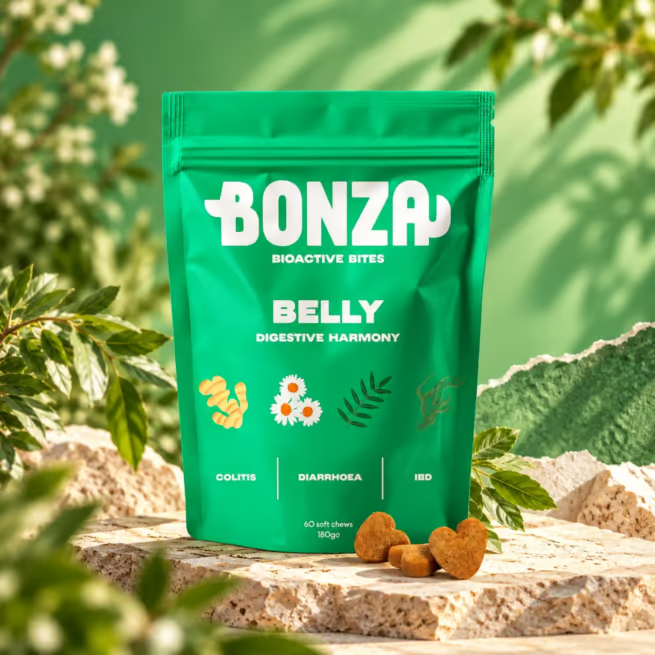
Belly is the most targeted supplement in the Bonza Bioactive Bites functional supplement range for the Cocker Spaniel’s gastrointestinal profile. Its formulation addresses digestive sensitivity, gut motility, and mucosal support, which are the three areas most directly implicated in this breed’s characteristic presentations: food sensitivity, chronic enteropathy, and the mucosal barrier compromise that underpins protein malabsorption risk.
Voor Cocker Spaniels met een geschiedenis van gevoelige spijsvertering, periodiek zachte ontlasting of diarree, of die herstellende zijn van een chronische enteropathie onder veterinair beheer, biedt Belly gerichte bioactieve ondersteuning voor het darmslijmvlies en de motiliteitspatronen die ten grondslag liggen aan een consistente spijsvertering.
Biotica: De Universele Microbioom Stichting
Regardless of primary presentation, every Cocker Spaniel benefits from a consistent, daily microbiome foundation. Bonza’s Biotics prebiotic, probiotic and postbiotic supplement delivers the full Biotics Triad: prebiotics to feed beneficial bacteria; Calsporin® (Bacillus velezensis DSM 15544), Bonza’s live probiotic, which supports gut-associated immune regulation and microbiome stability; and postbiotics including TruPet™ en Lactobacillus helveticus HA-122, which support mucosal immune function through heat-inactivated microbial components. This triad directly addresses the core vulnerability of the Cocker Spaniel’s gut: the tendency toward dysbiosis, mucosal compromise, and immune over-activation at the intestinal wall.
Blok: De alternatieve leidraad voor immuun-huidpresentaties
For Cocker Spaniels whose primary presentation is food sensitivity with concurrent atopic skin disease, immune reactivity, or signs pointing more strongly toward the gut-skin axis than gastrointestinal protein loss, Block is the recommended alternative lead. Block addresses the gut-skin-immune intersection and is positioned as an alternative to Belly rather than a supplement to be stacked alongside it. A Cocker Spaniel with chronic itching, recurrent skin infections, and digestive sensitivity that responds to elimination diet is a Block candidate. A Cocker Spaniel with weight loss, chronic soft stools, and low albumin is a Belly and Biotics candidate, with urgent veterinary assessment as the priority.
De darmgezondheid van uw Cocker Spaniel ondersteunen: Een praktische gids
Het ondersteunen van de darmgezondheid van een Cocker Spaniel is een langetermijnverbintenis die dagelijkse voeding, proactieve controle en een nauwe samenwerking met een vertrouwde dierenarts omvat. De volgende stappen bieden een praktisch kader op basis van wat het bewijs ondersteunt.
Een hoogwaardig, consistent basisdieet vaststellen
Choose a complete, nutritionally balanced diet that avoids the most common canine allergens (beef, dairy, chicken, lamb, pork, corn, soy or wheat) where possible. Consistency matters: frequent diet changes disrupt the gut microbiome and can trigger or worsen food sensitivity in predisposed dogs. If your Cocker Spaniel has a history of digestive issues, speak with your vet before changing foods.
Biotica introduceren als dagelijkse basis voor het microbioom
Begin met Bonza’s Biotics supplement als een consistente dagelijkse toevoeging aan de routine van je Cocker Spaniel. De volledige Biotics Triad ondersteunt de diversiteit van het microbioom, de regulatie van het immuunsysteem van het slijmvlies en de productie van gunstige postbiotische metabolieten die de darmwand beschermen.
Belly toevoegen voor gerichte ondersteuning van slijmvlies en spijsvertering
Als je Cocker Spaniel een geschiedenis heeft van chronische zachte ontlasting, intermitterende diarree, voedselgevoeligheid of als er chronische enteropathie is vastgesteld, voeg dan Belly toe naast Biotics. Belly biedt bioactieve ondersteuning die specifiek gericht is op de darmpresentaties die het meest voorkomen bij dit ras. Voor honden bij wie een immuunreactieve huidziekte de belangrijkste zorg is, overweeg dan Block als alternatieve leidraad.
Controleer wekelijks het lichaamsgewicht, de vachtconditie en de consistentie van de ontlasting.
Gewichtsverlies is een van de vroegste en meest voorkomende tekenen van gastro-intestinale malabsorptie bij honden. Weeg uw Cocker Spaniel wekelijks en houd dit eenvoudig bij. Veranderingen in de vachtkwaliteit, aanhoudende losse ontlasting of onverklaarbare lethargie rechtvaardigen een veterinaire beoordeling.
Vraag Taurine screening en hartbewaking aan vanaf middelbare leeftijd
Gezien de gedocumenteerde aanleg voor taurinedeficiëntie bij zowel Engelse als Amerikaanse Cocker Spaniels, moet je met je dierenarts praten over taurineplasmascreening vanaf een leeftijd van ongeveer vijf jaar en vragen naar echocardiografische monitoring als onderdeel van routinematige gezondheidscontroles. Dit is een rasspecifieke klinische prioriteit, ongeacht het dieet.
Voer een eliminatiedieet uit als voedselovergevoeligheid wordt vermoed
Een minimaal acht weken durend eliminatiedieet met gehydrolyseerd eiwit of een echte nieuwe eiwitbron is nodig om voedselresponsieve enteropathie vast te stellen. Traktaties, kauwtabletten en gearomatiseerde supplementen moeten tijdens de proefperiode worden geweerd. Doe dit alleen onder begeleiding van een dierenarts.
Twee keer per jaar een veterinaire gezondheidscontrole plannen
Cocker Spaniels met bekende gastro-intestinale kwetsbaarheden hebben baat bij zesmaandelijkse gezondheidscontroles met serumalbumine, totaal eiwit en het scoren van de lichaamsconditie. Het vroegtijdig opsporen van hypoalbuminemie voordat de klinische symptomen ernstig worden is de meest zinvolle interventie die beschikbaar is.
Veiligheidsoverwegingen en wanneer naar de dierenarts gaan
The supplements described in this article are designed to support everyday gut health in Cocker Spaniels and are not intended to replace veterinary treatment. The following situations require prompt veterinary assessment rather than nutritional intervention alone.
Raadpleeg onmiddellijk een dierenarts als uw Cocker Spaniel een van de volgende verschijnselen vertoont: plotseling of onverklaarbaar gewichtsverlies; aanhoudend braken gedurende meer dan 24 uur; overvloedige, waterige diarree of diarree met bloed; zichtbare buikzwelling; zwelling van de ledematen of onder de buik; ademhalingsmoeilijkheden; of instorten.
Deze symptomen kunnen wijzen op een eiwit-verliezende enteropathie, darmobstructie, acuut hemorragisch diarree syndroom of andere aandoeningen die dringend klinisch behandeld moeten worden. Vooral PLE is een medisch noodgeval wanneer het ernstig is: hypoalbuminemie onder 20g/L is een erkende negatieve prognostische indicator en vroegtijdig ingrijpen verandert de uitkomst aanzienlijk.¹ ²
Voor Cocker Spaniels die al onder behandeling zijn van een dierenarts voor chronische enteropathie, PLE of hartaandoeningen, bespreek voedingsveranderingen, inclusief nieuwe supplementen, altijd met je dierenarts voordat je ze introduceert. Dit is vooral relevant wanneer immunosuppressieve medicatie wordt gebruikt.
Veelgestelde vragen
Zijn Cocker Spaniels gevoelig voor darmproblemen?
Cocker Spaniels hebben een gedocumenteerde associatie met chronische inflammatoire enteropathie en inflammatoire darmziekten en komen voor in PLE-caseseries in doorverwijzende veterinaire ziekenhuizen. Ze zijn niet het ras met het hoogste risico op een enkele gastro-intestinale aandoening, maar de combinatie van immuunreactiviteit aan de darmwand, aanleg voor voedselgevoeligheid en taurinedeficiëntie betekent dat darmgezondheid consistente aandacht verdient bij dit ras.
Wat is de beste voeding voor een Cocker Spaniel met een gevoelige maag?
Er is niet één enkel best dieet, maar het bewijs ondersteunt een compleet, consistent gevoerd dieet dat bekende allergenen vermijdt, diverse voedingsvezels biedt om het darmmicrobioom te ondersteunen en nutritioneel uitgebalanceerd is volgens FEDIAF- of AAFCO-equivalente normen. Als de gevoeligheid aanzienlijk is, is een veterinaire proef met een eliminatiedieet met gehydrolyseerd eiwit of een nieuwe eiwitbron de eerste op bewijs gebaseerde stap.
Kan een Cocker Spaniel een eiwit-verliezende enteropathie ontwikkelen?
Ja. PLE kan zich ontwikkelen als een complicatie van chronische inflammatoire enteropathie bij Cocker Spaniels. Het vereist veterinaire diagnose en behandeling. Waarschuwingssignalen zijn onder andere onverklaarbaar gewichtsverlies, aanhoudende diarree, buikzwelling en oedeem aan de ledematen. Elk van deze symptomen rechtvaardigt onmiddellijke veterinaire beoordeling.
Hebben Cocker Spaniels taurinesupplementen nodig?
Niet automatisch, maar zowel Engelse als Amerikaanse Cocker Spaniels hebben een gedocumenteerde rasspecifieke aanleg voor taurinedeficiëntie en gedilateerde cardiomyopathie. De juiste reactie is veterinaire taurine-plasmascreening en echocardiografische controle vanaf het midden van de levensloop, geen ongesuperviseerde suppletie. Bespreek dit met je dierenarts.
Hoe beïnvloedt het darmmicrobioom de gezondheid van een Cocker Spaniel?
The gut microbiome plays a direct role in maintaining the mucosal barrier, regulating immune responses at the gut wall, and producing metabolites including short-chain fatty acids that are essential for intestinal health. In dogs with chronic enteropathy and PLE, measurable dysbiosis has been documented. Supporting the microbiome through consistent prebiotic, probiotic, and postbiotic supplementation is one of the most evidence-supported nutritional strategies available.
Kan probiotica een Cocker Spaniel met darmziekte helpen?
Bij honden met chronische inflammatoire enteropathie zijn probiotica en synbiotica in verband gebracht met verbeteringen in klinische activiteit en samenstelling van het mucosale microbioom. Het bewijs is het sterkst wanneer probiotica worden gebruikt als onderdeel van een uitgebreid dieet en veterinair managementplan in plaats van als een op zichzelf staande interventie. Calsporin(Bacillus velezensis DSM 15544), de probiotische stam die wordt gebruikt in Bonza’s Biotics, is geformuleerd voor darmgerelateerde immuunondersteuning bij honden.
Is graanvrij voer slecht voor het hart van Cocker Spaniels?
De hypothese dat graanvrije of peulvruchtrijke diëten verwijde cardiomyopathie bij honden veroorzaken, is niet bewezen. Taurinedeficiëntie bij Cocker Spaniels is een rasspecifieke metabole gevoeligheid met een multifactoriële etiologie, waarbij genetica, individuele metabole verschillen en variatie op rasniveau in de transsulfuratieroute een rol spelen. Veterinaire taurinescreening en hartbewaking zijn de juiste klinische reacties.
Conclusie
De Cocker Spaniel is een ras waarvan de darmgezondheid meer aandacht verdient dan het meestal krijgt. Achter de vrolijke buitenkant schuilt een immuunsysteem dat reactiever is aan de darmwand dan de meeste rassen, een spijsverteringssysteem dat vatbaar is voor voedselgevoeligheid en chronische enteropathie, en een metabolisme dat een gedocumenteerde vatbaarheid heeft voor taurinetekort en gedilateerde cardiomyopathie. Dit zijn geen redenen voor paniek. Het zijn redenen voor weloverwogen, proactief management.
Het darmmicrobioom staat centraal in het gezondheidsbeeld van dit ras op de lange termijn. Diversiteit van het microbioom, integriteit van de slijmvliesbarrière en de consistente productie van gunstige metabolieten zoals butyraat en secundaire galzuren maken het verschil tussen een Cocker Spaniel met een veerkrachtige darmgezondheid en een Cocker Spaniel die vastzit in de dysbiose-inflammatie-malabsorptiecyclus die kenmerkend is voor de slechtste resultaten bij dit ras. Het microbioom consequent ondersteunen met de juiste prebiotische substraten, een gevalideerd levend probioticum en postbiotische immuunondersteuning is geen optionele extra. Het is de meest zinvolle preventieve investering die een Cocker Spaniel eigenaar kan doen.
Wat het bewijs duidelijk maakt, is dat de darmgezondheid van Cocker Spaniels geen probleem is dat één keer kan worden opgelost en daarna kan worden vergeten. Het is een voortdurende biologische realiteit die meetbaar en betekenisvol reageert op wat je elke dag doet. Geef ze goed te eten, houd ze goed in de gaten en werk samen met een dierenarts die de specifieke kwetsbaarheden van dit ras begrijpt. De darm-immuunas in je Cocker Spaniel is altijd in gesprek met de keuzes die je maakt. Controleer of het de juiste signalen ontvangt.
Craven MD, Washabau RJ. Vergelijkende pathofysiologie en management van eiwit-verliezende enteropathie. J Vet Intern Med. 2019;33(2):383-402. doi: 10.1111/jvim.15406. PMID: 30762910. PMC: 6430879.
Dossin O, Lavoué R. Eiwitverliezende enteropathieën bij de hond. Vet Clin North Am Small Anim Pract. 2011;41(2):399-418. doi: 10.1016/j.cvsm.2011.02.002. PMID: 21486643.
Hawes C, Kathrani A. In-hospital mortaliteit bij honden met eiwit-verliezende enteropathie en geassocieerde risicofactoren. J Vet Intern Med. 2024;38(4):2265-2272. doi: 10.1111/jvim.17123. PMID: 38819636. PMC: 11256150
Kathrani A, Werling D, Allenspach K. Hondenrassen met een hoog risico op het ontwikkelen van inflammatoire darmziekten in het zuidoosten van het Verenigd Koninkrijk. Dierenarts Rec. 2011;169(24):635. doi: 10.1136/vr.d5380. PMID: 21896567.
Dandrieux JRS. Inflammatoire darmziekte versus chronische enteropathie bij de hond: zijn ze hetzelfde? J Small Anim Pract. 2016;57(11):589-599. doi: 10.1111/jsap.12588. PMID: 27747868.
Kittleson MD, Keene B, Pion PD, Loyer CG. Results of the multicenter spaniel trial (MUST): taurine- en carnitine-responsieve gedilateerde cardiomyopathie bij Amerikaanse Cocker Spaniels met verlaagde plasma taurine concentratie. J Vet Intern Med. 1997;11(4):204-211. doi: 10.1111/j.1939-1676.1997.tb00092.x. PMID: 9298474.
Basili M, Pedro B, Hodgkiss-Geere H, Navarro-Cubas X, Graef N, Dukes-McEwan J. Low plasma taurine levels in English cocker spaniels diagnosed with dilated cardiomyopathy. J Small Anim Pract. 2021;62(7):570-579. doi: 10.1111/jsap.13306. PMID: 33594697.
Suchodolski JS, Markel ME, Garcia-Mazcorro JF, Unterer S, Heilmann RM, Dowd SE, Kachroo P, Ivanov I, Minamoto Y, Dillman EM, Steiner JM, Cook AK, Toresson L. Het fecaal microbioom bij honden met acute diarree en idiopathische inflammatoire darmziekte. PLoS ONE. 2012;7(12):e51907. doi: 10.1371/journal.pone.0051907. PMID: 23300577.
Cagnasso F, Suchodolski JS, Borrelli A, Borella F, Bottero E, Benvenuti E, Ferriani R, Tolbert MK, Chen CC, Giaretta PR, Gianella P. Dysbiose-index en fecale concentraties van sterolen, langeketenvetzuren en ongeconjugeerde galzuren bij honden met inflammatoire proteïne-verliezende enteropathie. Front Microbiol. 2024;15:1433175. doi: 10.3389/fmicb.2024.1433175. PMID: 39464397. PMC: 11505111.
Suchodolski JS. Analyse van het darmmicrobioom bij honden en katten. Vet Clin Pathol. 2022;50(Suppl 1):6-17. doi: 10.1111/vcp.13031. PMID: 34514619. PMC: 9292158.
Redactionele informatie
Veld
Detail
Gepubliceerd
[Datum van publicatie].
Laatst bijgewerkt
[Datum van bijwerking]. Dit artikel wordt jaarlijks herzien en bijgewerkt op basis van het huidige, collegiaal getoetste bewijsmateriaal.
Dit artikel dient alleen ter informatie en is geen veterinair advies. Raadpleeg altijd een gekwalificeerde dierenarts voordat u wijzigingen aanbrengt in het dieet of de supplementen van uw hond.
"Door dierenartsen goedgekeurd" klinkt als een garantie. Uit de feiten over hoe weinig aandacht dierenartsen daadwerkelijk besteden aan voeding, en over wie de klinieken…
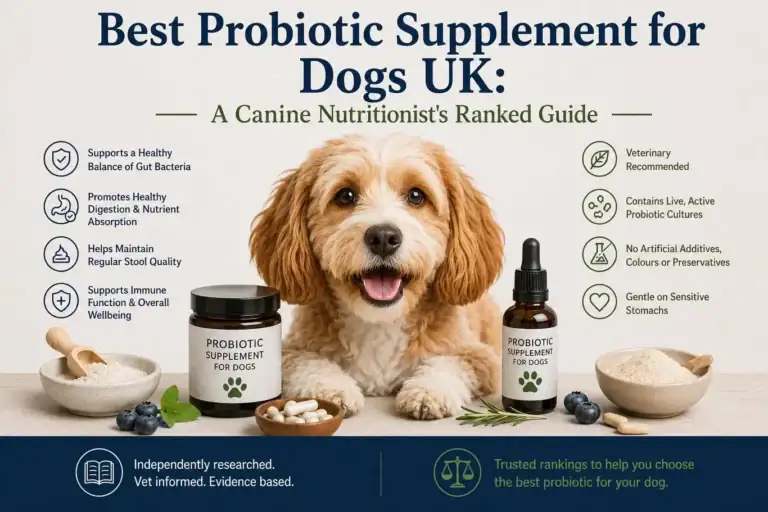
De meeste lijsten met "beste probiotica voor honden" zijn gebaseerd op populariteit. Deze scoort elk Brits supplement aan de hand van een expliciete methodologie:…

 EN · English
 DE · Deutsch
 ES · Español
 FR · Français