De complete dagelijkse basis · Voor gezond ouder worden
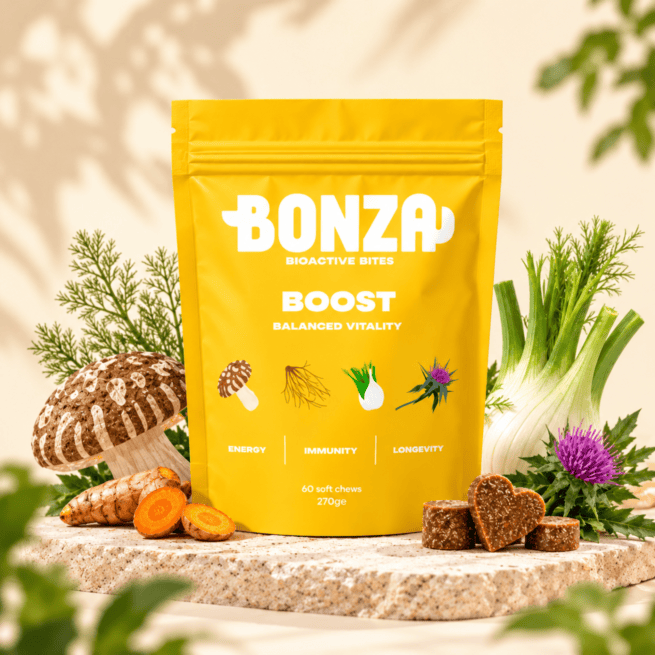
Eén kauwsnoepje per dag, en alles waar het lichaam van je hond op rekent. Boost brengt een compleet vitamine- en mineralencomplex samen met taurine, L-carnitine, DHAgold™-algen, gewrichtsvoedingsstoffen, adaptogenen en een basis van prebiotica, probiotica en postbiotica: 40 gerichte bioactieve stoffen in één dagelijks kauwsnoepje, in plaats van een plank vol losse potjes. Het is de dagelijkse basis voor elke volwassen hond en wordt met elk jaar belangrijker, door de vitaliteit, de heldere geest en de comfortabele beweging te ondersteunen waarmee een oudere hond elke dag geniet.
Gemaakt zonder vlees, tarwe, soja of maïs, is Boost zacht genoeg om elke dag te geven, met elk ingrediënt en elk inclusieniveau volledig vermeld.
One Gut. Whole Dog.™
£26.10£0.44/dag - Onder 10 kgAbonneer en bespaar £2.90 per leveringAbonneer en bespaar £2.90 per leveringBespaar £2.90 per leveringBespaar £2.90
Home » Hondengezondheid » Beste darmgezondheidssupplementen voor Labradors: Een hondenvoedingsgids
Beste darmgezondheidssupplementen voor Labradors: Een hondenvoedingsgids
Door Glendon Lloyd, Dip. Dog Nutrigenomics (Distinction), Dip. Canine Nutrition (Distinction) · Oprichter, Bonza
Beoordeeld door de veterinaire adviesraad
Laatst beoordeeld april 2026
Leestijd 25 min
Samenvatting
Labrador Retrievers carry a clinically distinctive gut health profile driven by three converging vulnerabilities: a documented deletion in the POMC gene that disrupts satiety signalling in approximately one in four of the breed; a consistent pattern of adverse food reactions documented across multiple peer-reviewed studies; and a recognised predisposition to inflammatory bowel disease en protein-losing enteropathy at the severe end of the spectrum. Together, these create a gut-metabolic en gut-immune landscape that demands targeted nutritional support. This guide, written by a canine nutritionist holding qualifications in both canine nutrition and canine nutrigenomics, sets out the evidence base for Labrador gut vulnerability and presents a supplement protocol built specifically around Bonza’s Biotics, Boost, and Belly Bioactive Bites. The goal is a practical, science-grounded protocol that any Labrador owner can implement with confidence.
Je Labrador is niet hebzuchtig. Dat is wat de wetenschap uiteindelijk bevestigt, ook al voelt het als een schrale troost als je 250 gram voer afmeet terwijl je hond je aanstaart met de absolute overtuiging dat je hem uithongert.
Labradors zijn het ras dat in de veterinaire literatuur het sterkst in verband wordt gebracht met voedselmotivatie en obesitas, en jarenlang was de verklaring die aan eigenaren werd aangeboden gedragsmatig: te weinig beweging, te veel lekkers, een hond die had geleerd om effectief te bedelen. Wat onderzoek, gepubliceerd in Cell Metabolism in 2016, duidelijk maakte, is dat voor ongeveer één op de vier Labradors de drang om te eten helemaal geen aangeleerd gedrag is. Het is in het genoom geschreven.¹ Een deletie van 14 basisparen in het pro-opiomelanocortine (POMC)-gen verstoort de productie van twee neuropeptiden, bèta-melanocyten-stimulerend hormoon (bèta-MSH) en bèta-endorfine, die verantwoordelijk zijn voor het signaleren van volheid na een maaltijd. Honden met deze deletie krijgen niet hetzelfde “ik heb genoeg gegeten”-signaal als hun soortgenoten zonder de deletie. De honger is biologisch, niet gedragsmatig, en wordt niet uitgeschakeld.
The gut consequences of that biology are what this article is about. Chronic hyperphagia and the resulting obesity do not stay localised to weight and appetite. They create conditions inside the gut that compound the Labrador’s other documented vulnerabilities: a consistent pattern of adverse food reactions, and a predisposition to inflammatory bowel disease at the more serious end of the spectrum. The result is a breed whose gut health needs more than a generic probiotic and a hopeful attitude. What follows is the supplement protocol I would build for a Labrador, starting from the science and ending with practical guidance on how to implement it.
Belangrijkste opmerkingen
Ongeveer één op de vier Labradors is drager van de POMC-gen deletie, die hyperfagie, obesitas en een directe weg naar darm-metabole dysbiose veroorzaakt.
De darm-metabole as is het dominante klinische kader voor de darmgezondheid van Labradors: gewichtsregulatie, ontstekingstoon en microbioomsamenstelling zijn allemaal biologisch met elkaar verbonden in dit ras.
Labradors komen consequent naar voren in meerdere collegiaal getoetste onderzoeken als een van een kleine groep rassen die oververtegenwoordigd zijn in gevalseries van ongewenste voedselreacties
Calsporin® (Bacillus velezensis DSM 15544) is het enige door de EFSA goedgekeurde levende sporenvormende probioticum voor honden en de hoeksteen van elk darmsupplement voor Labradors.
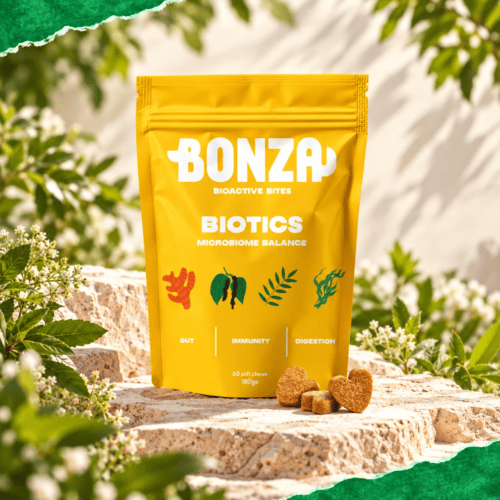
Biotics Bioactive Bites levert de complete Biotics Triad: prebiotica, levende probiotica en postbiotica, als de niet-onderhandelbare microbiome basis voor dit ras.
Boost Bioactive Bites richt zich rechtstreeks op de darm-metabole as en ondersteunt de metabole gevolgen van de POMC-mutatie en de obesitas-dysbiosecyclus.
Voor Labradors met actieve spijsverteringssymptomen, chronische enteropathie of darmverstoring na antibiotica biedt Belly Bioactive Bites gerichte ondersteuning voor de spijsvertering naast Biotics.
Waarom de darmgezondheid van Labradors bepalend is voor hun behoefte aan supplementen
De aanvullende behoeften van de Labrador zijn niet willekeurig. Ze zijn het directe gevolg van drie biologisch verschillende kwetsbaarheden in de darmen die samen dit ras tot een van de meest voedingscomplexe rassen maken om te ondersteunen.
For a full clinical exploration of the Labrador’s gut health profile, including the POMC mutation, IBD predisposition, and the eight gut-organ axes most relevant to the breed. Read our complete guide: Labrador Retriever Gut Health: The Hunger Gene Problem. What follows here focuses on what to do about it.
De POMC-mutatie en de darm-metabole as
De 14 basispaar deletie in het POMC-gen, voor het eerst beschreven door Raffan en collega’s van de Universiteit van Cambridge in 2016, heeft een allelfrequentie van 12% in de Labradorpopulatie, wat betekent dat ongeveer 23 tot 25% van de honden ten minste één kopie draagt.¹ De deletie verstoort de coderende sequenties voor bèta-MSH en bèta-endorfine, neuropeptiden die werken binnen de melanocortinepathway om verzadiging na het eten te signaleren. Honden die drager zijn van de mutatie ervaren een verminderde verzadigingssignalering, een grotere voedselmotivatie en een statistisch hoger lichaamsgewicht, waarbij elk deletie-allel zorgt voor een toename van 0,33 standaarddeviaties in gewicht, wat overeenkomt met ongeveer 1,9 kg per allel.¹
That weight gain matters for the gut. Excess adipose tissue is metabolically active: it generates chronic low-grade systemic inflammation, drives oxidative stress, and alters the fermentation environment within the colon. Research comparing the fecal microbiome of obese and normal weight dogs has consistently found compositional differences at the phylum level, with obese dogs showing shifts in the Firmicutes to Bacteroidetes ratio and alterations in the genera associated with short-chain fatty acid (SCFA) production.⁴ SCFAs, butyrate, propionate, and acetate, are critical regulators of gut barrier integrity, immune signalling, and energy metabolism. When their production is disrupted by dysbiosis, the effects are not confined to the gut.
This is the gut-metabolic axis in practice: a genetic predisposition to excess weight creates a gut environment that amplifies metabolic dysfunction, which in turn compounds the original metabolic pressure. For the Labrador, the loop is particularly tight because the hunger gene that drives weight gain is the same gene that initiates the microbiome disruption.
Bijwerkingen van voedsel
Labradors appear consistently among a small group of breeds over-represented in adverse food reaction case series. A 2019 critically appraised topic review published in BMC Veterinary Research, drawing on data from multiple peer-reviewed studies across different countries and time periods, found that German Shepherd Dogs, West Highland White Terriers, and Labrador en Golden Retrievers together accounted for approximately 40% of dogs presenting with cutaneous adverse food reactions.² The review authors acknowledged that no firm causal predisposition data exists, but noted the repeated appearance of these breeds across studies conducted in different contexts as a consistent observational signal.
Adverse food reactions add a gut-immune dimension to the Labrador’s profile. Immune activation in response to food antigens compounds microbiome instability, increases intestinal permeability, and sustains the inflammatory environment that obesity has already primed.
IBD-predispositie en eiwit-verliezende enteropathie
At the more serious end of the spectrum, Labrador Retrievers have been identified among breeds with elevated odds for enteropathy in large-scale UK veterinary data.³ The most severe manifestation within the chronic enteropathy spectrum is protein-losing enteropathy (PLE), a syndrome in which gut inflammation or lymphatic dysfunction causes excessive protein loss through the intestinal wall. PLE carries a guarded prognosis and requires veterinary diagnosis and management. For the majority of Labrador owners, concern is more appropriately focused on the earlier parts of that spectrum: food-responsive or immune-mediated enteropathy presenting as chronic loose stools, fluctuating digestive consistency, and poor nutrient absorption.
Across all three of these presentations, the gut microbiome is an actionable target. Dysbiosis is documented in obesity, adverse food reactions, and chronic enteropathy. Supporting microbial diversity and resilience is the logical starting point for any Labrador gut health strategy.
Drie Bonza producten pakken samen de darm-metabole en darm-immuun kwetsbaarheid van de Labrador aan: Biotics als de niet-onderhandelbare basis voor het microbioom, Boost als ondersteuning van de darm-metabole as en Belly voor honden met actieve spijsverteringssymptomen of chronische enteropathie.
Biotics Bioactieve hapjes: Stichting Microbioom
Every Labrador gut protocol starts here. Biotics Bioactive Bites delivers the complete Biotics Triad: prebiotics, a live probiotic, and postbiotics, in a single daily supplement designed to support the gut microbiome at three distinct levels.
The centrepiece is Calsporin® (Bacillus velezensis DSM 15544), the only live spore-forming probiotic strain with EFSA authorisation specifically for dogs.⁵ Calsporin® is categorised as a zootechnical additive in the functional group of gut flora stabilisers (EU identification number 4b1820). Unlike conventional probiotic strains such as Lactobacillus and Bifidobacterium, which begin to degrade above approximately 49°C and are frequently non-viable by the time they reach the canine intestine, Calsporin® survives as a heat-resistant endospore through manufacturing and through gastric acid, bile salts, and digestive enzymes, germinating in the large intestine where it is needed most. The 2017 EFSA scientific opinion confirmed its safety for dogs and its efficacy for improving faecal consistency, enhancing gut microbiota diversity, and increasing faecal IgA levels.⁵
The prebiotic layer comprises two named ingredients: Fibrofos™ 60 (minimum 60% inulin, sourced from Cosucra) and Biolex® MB40 (beta-glucans, sourced from Leiber GmbH). These fermentable substrates selectively feed Bifidobacterium and Faecalibacterium populations, supporting the production of butyrate and other SCFAs that are particularly depleted in the obese and dysbiotic Labrador gut.⁶
The postbiotic layer includes L. helveticus HA-122, a heat-inactivated strain that functions as a postbiotic through its structural components and metabolic products, and TruPet™, a standalone postbiotic that contributes bioactive compounds without requiring a live organism to survive gut transit. Both are named individually in all full Biotics Triad descriptions because their contributions are distinct from one another and from the live probiotic.
For the Labrador specifically, Biotics addresses the dysbiosis that flows from obesity, the immune dysregulation associated with adverse food reactions, and the microbiome instability common to chronic enteropathy. It is the supplement that does not vary with clinical presentation: every Labrador benefits from it, regardless of whether their primary concern is weight, sensitivity, or digestive symptoms.
Boost Bioactive Bites: ondersteuning van de darm-stofwisselingsas
Als Biotics de basis is, dan is Boost het supplement dat het meest direct de genetica van de Labrador aanspreekt.
Boost Bioactive Bites is Bonza’s gezondheidssupplement voor het hele lichaam en de stofwisseling. Het is geen afslankproduct, het beweert niet de eetlust te verminderen of vet te verbranden, maar het pakt de gevolgen aan van de POMC-mutatie op de darm-metabole as en de obesitas-dysbiosecyclus die daardoor in gang wordt gezet. De formule is ontworpen om de stofwisselingsfunctie, het ontstekingsbalans en het welzijn op lange termijn te ondersteunen bij honden waarvan het genetisch profiel hun stofwisseling onder chronische druk zet.
For the Labrador owner managing a dog that gains weight on a measured diet, that requires ongoing portion discipline, or that carries a higher body condition score despite conscientious feeding, Boost provides the metabolic health and longevity support layer that Biotics alone cannot offer. It targets the systemic consequences of the gut-metabolic axis, the chronic low-grade inflammation, the metabolic inefficiency, the whole-body wellness dimension that flows from a compromised gut-metabolic relationship.
Positioning is important here: Boost is not a substitute for dietary management or veterinary guidance on weight. It is a complement to both, addressing the biological environment that makes weight management harder for POMC-affected Labradors than it is for most other dogs.
Shop Boost voor Labradors
Buik Bioactieve Hapjes: Voor spijsverteringsproblemen en chronische enteropathie
Belly Bioactive Bites is the acute-to-ongoing digestive support layer, and for Labradors with pronounced gut symptoms it sits alongside Biotics rather than replacing it.
The clinical contexts where Belly is most directly relevant are loose stools, chronic digestive inconsistency, food sensitivity reactions with gastrointestinal signs, post-antibiotic gut disruption, and dogs with confirmed or suspected food-responsive enteropathy. For the subset of Labradors with IBD or PLE, where veterinary management is the primary intervention, Belly provides complementary nutritional support for gut barrier integrity and microbial balance during and after treatment.
Belly addresses the digestive end of the gut-immune axis. Where Biotics works at the microbiome level and Boost addresses metabolic consequences, Belly provides targeted ingredients that support the gut mucosa and the local digestive environment that food sensitivity and chronic enteropathy disrupt most directly.
De biotica-triade: Waarom fundament belangrijk is voor Labradors
The Biotics Triad: prebiotics, a live probiotic, and postbiotics operating together, is the framework that underpins Biotics Bioactive Bites. In a breed where dysbiosis is driven by three distinct and converging mechanisms (obesity, immune dysregulation, and chronic enteropathy), the case for addressing the microbiome at multiple levels simultaneously is stronger than it is for most other breeds.
Prebiotische suppletie ondersteunt de groei van gunstige bacteriepopulaties en de productie van SCFA’s. Onderzoek bij zwaarlijvige honden heeft aangetoond dat prebiotica-supplementatie met korte-keten fructooligosacchariden (scFOS, een verbinding met structurele gelijkenissen met inuline) de microbiële diversiteit en microbiota-samenstelling positief beïnvloedt in een richting die geassocieerd wordt met verbeterde metabole resultaten.⁶ Fibrofos™ 60 levert een inulinegehalte van minimaal 60% als een geconcentreerd prebiotisch substraat.
Het levende probioticum (Calsporin®) staat centraal in de Triade als de enige door de EFSA goedgekeurde levende sporenvormende stam voor honden, die zowel directe als immunomodulerende effecten heeft in de darmen van honden.⁵ De postbiotica (L. helveticus HA-122 en TruPet™) vergroten het bereik van de Triade verder dan wat levende organismen alleen kunnen bereiken, door bioactieve verbindingen bij te dragen via een mechanisme dat niet afhankelijk is van overleving door productie of darmtransit.
Voor de Labrador zijn alle drie de niveaus klinisch relevant. De Biotics Triad is geen interventie met slechts één mechanisme, maar een benadering op systeemniveau van microbioomondersteuning die past bij de complexiteit van de darmkwetsbaarheid van het ras.
Beste probiotica voor de darmgezondheid van Labradors
When owners search for the best probiotic for their Labrador, they are usually confronted with an overwhelming number of products making similar-sounding claims about live bacteria and gut health benefits. The question worth asking is not which probiotic sounds most convincing on its packaging, but which probiotic strain has been assessed for safety and efficacy in dogs by an independent regulatory body.
Het antwoord is Calsporin® (Bacillus velezensis DSM 15544). Het is de enige levende sporenvormende probiotische stam die een EFSA-goedkeuring heeft gekregen specifiek voor gebruik bij honden, beoordeeld volgens het Qualified Presumption of Safety (QPS) kader en bevestigd als niet-toxigene, vrij van zorgwekkende antimicrobiële resistentiegenen en veilig voor honden, eigenaren en het milieu.⁵
Voor de Labrador gaat de selectie van stammen verder dan de wettelijke status. De obesitasgerelateerde dysbiose van het ras gaat gepaard met verstoring van de microbiële diversiteit, SCFA-productie en ontstekingssignalering. Een probioticum dat de productiehitte of maagtransit niet kan overleven, zal de darm niet intact bereiken. De hittebestendige endosporenstructuur van Calsporin®, waarvan is bevestigd dat ze levensvatbaar is bij temperaturen van ten minste 90°C en meer dan 12 maanden stabiel blijft in huisdiervoedingsproducten door de technische beoordeling van de EFSA, pakt precies deze beperking aan.⁵
Conventionele probiotica op basis van Lactobacillus zijn niet zonder waarde, maar ze hebben te maken met fundamentele uitdagingen in de darmomgeving van honden die sporenvormende stammen niet hebben. Voor een Labrador die betrouwbare ondersteuning van het darmmicrobioom nodig heeft voor de metabole, immuun- en spijsverteringsdimensies die in het ras zijn gedocumenteerd, zijn de wettelijke en biologische argumenten voor Calsporin® het sterkst beschikbaar.
Prebiotica zijn de substraten die selectief nuttige bacteriepopulaties in de darm voeden. Ze zijn niet uitwisselbaar: verschillende prebiotische vezels fermenteren op verschillende snelheden, voeden verschillende bacteriesoorten en produceren verschillende SCFA-profielen. Specifiek voor Labrador zijn de prebiotica gericht op fructanen van het inuline-type en bètaglucanen.
Inuline (Fibrofos™ 60)
Inuline is een fructaan prebioticum afgeleid van cichoreiwortel. Met een inulinegehalte van minimaal 60% biedt Fibrofos™ 60 een geconcentreerd substraat voor Bifidobacterium- en Faecalibacterium-populaties, bacteriën die betrokken zijn bij de productie van butyraat en het behoud van de darmbarrière. Onderzoek bij zwaarlijvige honden toonde aan dat prebiotica-supplementatie van het inuline-type de microbiële diversiteitsindices verbeterde en de samenstelling van bacteriën die geassocieerd worden met betere metabolische resultaten positief beïnvloedde.⁶ Voor Labradors met POMC, waar metabolische dysbiose de gevolgen van overmatige adipositas verergert, is dit een doelgericht mechanisme.
Beta-glucanen (Biolex® MB40)
Beta-glucans from Biolex® MB40 (Leiber GmbH) complement the inulin fraction by providing a structurally distinct fermentable substrate and contributing to immune modulation through interaction with gut-associated lymphoid tissue. The gut-immune dimension of the Labrador’s profile, driven by adverse food reactions and enteropathy predisposition, makes beta-glucan support particularly relevant.
De combinatie van Fibrofos™ 60 en Biolex® MB40 binnen de Biotics Triad biedt een breder prebiotisch profiel dan enkelvoudige vezelproducten en pakt zowel de metabolische als de immuuncomponent van de kwetsbaarheid van de darmen van Labrador aan.
Beste supplementen voor Labrador gewichtsbeheersing en metabolische gezondheid
Gewichtsmanagement in de Labrador met POMC is een biologische uitdaging die verantwoordelijke voedingspraktijken kunnen aanpakken, maar niet volledig alleen kunnen oplossen. De mutatie reageert niet op wilskracht van de hond of de eigenaar. Waar het wel op reageert, op het niveau van de darmen, is gerichte ondersteuning van het microbioom en de stofwisseling, die naast en niet in plaats van voedingsdiscipline werkt.
De twee supplementen die het meest relevant zijn voor de metabolische dimensie van de darmgezondheid van Labradors zijn Biotics en Boost.
Biotics pakt de onderliggende dysbiose aan die obesitas veroorzaakt en in stand houdt. In de darm van de Labrador met obesitas vermindert een verstoorde SCFA-productie de signalen die verzadiging, energieregulatie en ontstekingscontrole ondersteunen. Het herstel van een meer diverse en veerkrachtige microbiële gemeenschap, door de gecombineerde werking van prebiotica, Calsporin® en postbiotica, creëert een darmomgeving die beter is toegerust om de metabolische eisen te ondersteunen die de genetica van het ras eraan stelt.
Boost richt zich op de downstream gevolgen van de verstoring van de darm-metabole as: de systemische ontsteking, de metabole inefficiëntie, de welzijnstekorten in het hele lichaam die zich opstapelen in een ras onder chronische metabole druk. Samen vormen Biotics en Boost een aanvullende benadering van de metabole gevolgen van de POMC-mutatie, geen vervanging voor dieetmanagement of veterinaire gewichtscontrole, maar een zinvolle biologische ondersteuningslaag voor die interventies.
Hoe deze supplementen samen gebruiken
Het onderstaande protocol is bedoeld voor de meerderheid van de volwassen Labrador-eigenaren. Puppy’s, drachtige of zogende teven en honden met gediagnosticeerde aandoeningen moeten altijd worden behandeld in overleg met een dierenarts.
Begin met biotica
Begin met Biotics Bioactive Bites als basis voor het microbioom. Introduceer over zeven tot tien dagen door te beginnen met de helft van de aanbevolen portie voor de eerste drie tot vijf dagen voordat je overgaat op de volledige hoeveelheid. Hierdoor kan het darmmicrobioom zich aanpassen zonder losse ontlasting of spijsverteringsproblemen te veroorzaken door de snelle verschuiving in het microbiële substraat.
Boost toevoegen na de eerste inwerkperiode
Zodra Biotics is ingeburgerd (meestal na twee tot drie weken), introduceer dan Boost Bioactive Bites als de darm-metabole as laag. Nogmaals, introduceer geleidelijk als je hond een gevoelige spijsvertering heeft.
Belly toevoegen bij spijsverteringssymptomen
Voor Labradors met losse ontlasting, chronische onregelmatigheden in de spijsvertering, verstoring door antibiotica of bekende voedselovergevoeligheidsreacties met maag-darmsymptomen, introduceer Belly naast Biotics. Belly en Biotics werken samen in plaats van na elkaar voor honden met actieve darmklachten.
Consistentie behouden
Supplementvoordelen stapelen zich op in de loop van de tijd. Het microbioom transformeert niet van de ene op de andere dag: betekenisvolle veranderingen in diversiteit en samenstelling vereisen consistente dagelijkse suppletie gedurende weken tot maanden. Stel een routine in, hetzelfde tijdstip van de dag, met eten, en houd je daaraan.
Bewaken en aanpassen
Let de eerste vier tot acht weken op veranderingen in de consistentie van de ontlasting, energieniveaus, vachtconditie en spijsverteringscomfort. Dit zijn de meest waarneembare indicatoren van verandering in het microbioom. Als de spijsverteringssymptomen verergeren of aanhouden, raadpleeg dan je dierenarts voordat je doorgaat.
Veiligheid, dosering en wanneer naar de dierenarts gaan
All three Bonza Bioactive Bites supplements are formulated for adult dogs and carry the dosage guidance on their respective product pages. Follow the dosage instructions for your Labrador’s weight and adjust as directed.
Interacties en contra-indicaties
Biotics, Boost, and Belly are functional nutritional supplements, not veterinary medicines. They are not intended to diagnose, treat, or cure any condition. Dogs on immunosuppressive therapy for IBD or other conditions should have their supplement protocol discussed with the prescribing vet before starting.
Wanneer moet je je dierenarts raadplegen?
Seek veterinary advice promptly if your Labrador develops any of the following signs: persistent vomiting, severe or bloody diarrhoea, marked weight loss despite normal or increased appetite, swollen abdomen, lethargy, or loss of appetite. These may indicate conditions including protein-losing enteropathy, intestinal obstruction, pancreatitis, or other serious gastrointestinal disease, all of which require veterinary assessment, laboratory diagnostics, and in many cases endoscopy or intestinal biopsy.
Als je dierenarts chronische enteropathie vermoedt, kan hij of zij serumalbumine meten, cobalamine (vitamine B12) bepalen, een cTLI-test (canine trypsin-like immunoreactivity) uitvoeren om exocriene pancreasinsufficiëntie uit te sluiten en een microbiota dysbiosis index voor honden uitvoeren om de verstoring van het darmmicrobioom te kwantificeren. Deze onderzoeken leveren bruikbare gegevens op die als leidraad kunnen dienen voor zowel dieet- als supplementbeslissingen.
Veelgestelde vragen
Wat is het beste darmgezondheidssupplement voor een Labrador?
Biotics Bioactive Bites is het onmisbare startpunt voor elk Labrador darmgezondheidsprotocol. Het levert de complete Biotics Triad, Fibrofos™ 60 en Biolex® MB40 als prebiotica, Calsporin® (Bacillus velezensis DSM 15544) als het enige door de EFSA goedgekeurde levende sporenvormende probioticum voor honden, en L. helveticus HA-122 en TruPet™ als genoemde postbiotica. De combinatie pakt het microbioom op drie verschillende niveaus aan, wat bijzonder relevant is voor een ras waarvan de darmgezondheid vanuit drie verschillende biologische richtingen tegelijk onder druk staat.
Dragen alle Labradors de POMC-mutatie?
Nee. Ongeveer één op de vier Labradors is drager van ten minste één kopie van de 14 basepaar POMC-deletie die in 2016 werd geïdentificeerd door Raffan en collega’s.¹ De deletie komt vaker voor bij Labradors die zijn geselecteerd als hulphond (gevonden in de meerderheid van de hulphondencohorten in de oorspronkelijke studie) dan bij gezelschapshonden. Labradors zonder de mutatie kunnen nog steeds profiteren van darmgezondheidssupplementen, omdat de aanleg van het ras voor negatieve voedselreacties en het risico op IBD niet afhankelijk zijn van de status van POMC-drager.
Welke supplementen ondersteunen de gewichtscontrole van Labradors?
Gewichtsmanagement bij Labradors, met name bij diegenen die drager zijn van de POMC-deletie, vereist dieetdiscipline en veterinaire begeleiding als primaire interventies. Op supplementniveau pakt Boost Bioactive Bites de gevolgen van de obesitas-dysbiosecyclus op de darm-metabole as aan. Biotics Bioactive Bites ondersteunt het microbioom waarvan de SCFA-productie en metabole signalering afhankelijk zijn. Geen van beide is een vervanging voor een goede caloriebeheersing, maar beide bieden een zinvolle biologische ondersteuning voor de metabole omgeving waarin gewichtsbeheersing plaatsvindt.
Mijn Labrador heeft een gevoelige maag. Met welk supplement moet ik beginnen?
Start with Biotics Bioactive Bites, introduced gradually over seven to ten days. Biotics is appropriate for all Labradors including those with sensitive digestion. If your dog has active loose stools, chronic digestive inconsistency, or a history of food sensitivity reactions, add Belly Bioactive Bites alongside Biotics. Belly is the supplement most specifically targeted at acute-to-ongoing digestive sensitivity and gut barrier support.
Wat is eiwit-verliezende enteropathie en moet ik me zorgen maken?
Eiwitverliezende enteropathie (PLE) is een syndroom waarbij een darmziekte overmatig eiwitverlies via de darmwand veroorzaakt, wat leidt tot gevaarlijk laag albuminegehalte in het bloed en geassocieerde complicaties zoals vochtophoping en trombo-embolie. Het vertegenwoordigt het ernstige einde van het spectrum van inflammatoire darmziekten en vereist een snelle veterinaire diagnose en behandeling. De meeste Labradors ontwikkelen geen PLE, maar eigenaars moeten zich vertrouwd maken met de waarschuwingssignalen, aanhoudend braken, diarree, aanzienlijk gewichtsverlies en buikzwelling, en onmiddellijk een dierenarts raadplegen als deze tekenen aanwezig zijn. Darmgezondheidssupplementen zijn geen behandeling voor PLE.
Kan ik Biotics en Belly tegelijkertijd geven?
Ja. Biotics en Belly zijn ontworpen om samen te werken voor honden met actieve spijsverteringssymptomen. Biotics zorgt voor de basis van het microbioom; Belly zorgt voor gerichte ondersteuning van de spijsvertering en de darmbarrière. Ze richten zich op complementaire mechanismen en kunnen veilig tegelijkertijd worden gebruikt bij volwassen Labradors.
Hoe lang duurt het voordat ik resultaat zie van darmsupplementen?
Zinvolle veranderingen in het microbioom hebben tijd nodig. De meeste eigenaren melden waarneembare verschillen in de consistentie van de ontlasting binnen twee tot vier weken, en bredere verbeteringen in vachtconditie, energie en spijsverteringscomfort binnen zes tot acht weken na consequente dagelijkse supplementatie. Veranderingen in de diversiteit van het microbioom vereisen langdurige suppletie gedurende meerdere maanden voor meer significante veranderingen.
Is Bonza voeding geschikt voor Labradors?
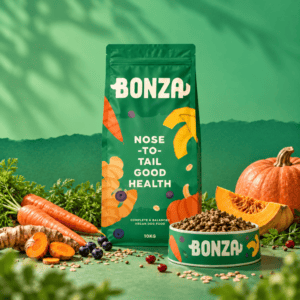
Yes. Bonza’s Superfoods and Ancient Grains is a nutritionally complete plant-based diet suitable for adult Labrador Retrievers. Given the breed’s caloric management requirements and obesity predisposition, accurate portion control is important and best confirmed with veterinary weight monitoring.
Conclusie
De Labrador Retriever is geen moeilijke hond om van te houden. Het is echter een ras waarvan de biologie meer vereist dan standaard voedingsdenken. De POMC-mutatie maakt het leven niet gemakkelijk, niet voor de hond en niet voor de eigenaar, maar het maakt het darm-metabole argument voor gerichte suppletie ongewoon duidelijk. Als de honger genetisch is, als de gewichtsdruk biologisch is en als de gevolgen van dat gewicht voor het microbioom gedocumenteerd zijn in peer-reviewed onderzoek, dan is het pleidooi voor een door Biotics geleid protocol niet speculatief. Het is het logische antwoord op de wetenschap.
Voor de meeste Labrador-eigenaren is het protocol eenvoudig: Biotics Bioactive Bites als de dagelijkse basis voor het microbioom, Boost Bioactive Bites toegevoegd zodra het goed werkt voor ondersteuning van de darm-metabole as, en Belly Bioactive Bites voor elke hond met actieve spijsverteringssymptomen, chronische gevoeligheid of verstoring van de darm na antibiotica. Deze combinatie van drie supplementen richt zich op de darm-metabole as, de darm-immuun as en de instabiliteit van het microbioom die beide verbindt, vanuit één samenhangende voedingsstrategie.
Niets van dit alles vervangt veterinaire begeleiding bij gewichtsbeheersing, onderzoek naar voedselgevoeligheid of diagnose van chronische enteropathie. Wat het doet, is de best mogelijke darmomgeving creëren waarbinnen die interventies kunnen werken. En voor een ras dat te maken heeft met de biologische tegenwind die de Labrador heeft, is dat geen optionele extra. Het is fundamenteel.
Raffan E, Dennis RJ, O’Donovan CJ, Becker JM, Scott RA, Smith SP, Withers DJ, Wood CJ, Conci E, Clements DN, Summers KM, German AJ, Mellersh CS, Arendt ML, Iyemere VP, Withers E, Söder J, Wernersson S, Andersson G, Lindblad-Toh K, Yeo GSH, O’Rahilly S. Een deletie in het POMC-gen bij de hond is geassocieerd met gewicht en eetlust bij Labrador retriever-honden die vatbaar zijn voor obesitas. Cell Metab. 2016;23(5):893-900. doi: 10.1016/j.cmet.2016.04.012. PMID: 27157046. PMC: PMC4873617.
Olivry T, Mueller RS. Critically appraised topic on adverse food reactions of companion animals (7): signalment and cutaneous manifestations of dogs and cats with adverse food reactions. BMC Vet Res. 2019;15(1):140. doi: 10.1186/s12917-019-1880-2. PMID: 31072328. PMC: PMC6507158.
Pegram, C., Woolley, C., Brodbelt, D.C. et al. Disorder predispositions and protections of Labrador Retrievers in the UK. Sci Rep11, 13988 (2021). doi: 10.1038/s41598-021-93379-2. PMID:
Kim H, Seo J, Park T, Seo K, Cho HW, Chun JL, Kim KH. Obese dogs exhibit different fecal microbiome and specific microbial networks compared with normal weight dogs. Sci Rep. 2023;13(1):723. doi: 10.1038/s41598-023-27846-3. PMID: 36639715. PMCID: PMC9839755
EFSA-panel voor toevoegingsmiddelen en producten of stoffen die in diervoeding worden gebruikt (FEEDAP). Veiligheid en werkzaamheid van Calsporin® (Bacillus subtilis DSM 15544) als toevoegingsmiddel voor diervoeding voor honden. EFSA J. 2017;15(4):e04760. doi: 10.2903/j.efsa.2017.4760.
Apper E, Privet L, Taminiau B, Le Bourgot C, Svilar L, Martin JC, Diez M. Relationships between gut microbiota, metabolome, body weight, and glucose homeostasis of obese dogs fed with diets differing in prebiotic and protein content. Micro-organismen. 2020;8(4):513. doi: 10.3390/microorganisms8040513. PMC: PMC7232476.
Dit artikel dient alleen ter informatie en is geen veterinair advies. Raadpleeg altijd een gekwalificeerde dierenarts voordat u wijzigingen aanbrengt in het dieet of de supplementen van uw hond.
"Door dierenartsen goedgekeurd" klinkt als een garantie. Uit de feiten over hoe weinig aandacht dierenartsen daadwerkelijk besteden aan voeding, en over wie de klinieken…
De meeste lijsten met "beste probiotica voor honden" zijn gebaseerd op populariteit. Deze scoort elk Brits supplement aan de hand van een expliciete methodologie:…

 EN · English
 DE · Deutsch
 ES · Español
 FR · Français